

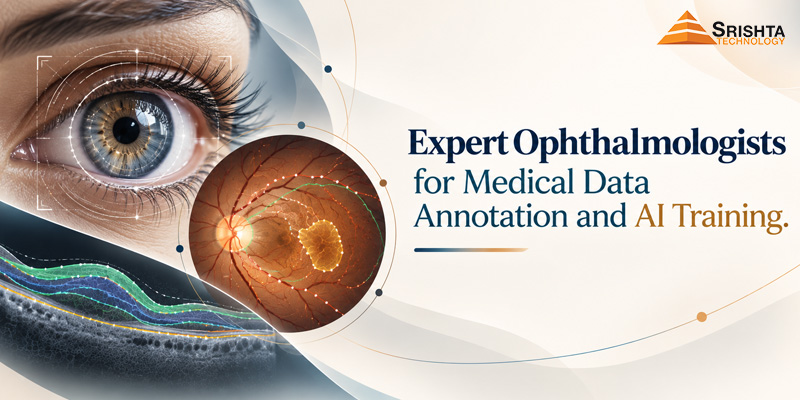
Artificial intelligence is becoming increasingly important in ophthalmology, with AI systems being developed to analyze retinal images, fundus photography, OCT scans, and other ophthalmic data.
But sophisticated AI models need more than large quantities of medical images.
They need accurately annotated, clinically relevant, and consistently labeled ophthalmology datasets.
When an AI project involves subtle retinal abnormalities, anatomical structures, lesions, or disease-related features, general data annotators may not always have the clinical knowledge required to interpret the data correctly.
This is where ophthalmologist-led medical data annotation becomes valuable.
Srishta Technology Private Limited provides specialized medical data annotation services and can build domain-expert annotation workflows for ophthalmology AI projects, helping organizations transform complex eye-imaging data into structured, AI-ready datasets.
Why Does Ophthalmology AI Need Expert Data Annotation?
Consider a retinal fundus image.
To an ordinary annotator, it may simply appear to be an image of the retina.
An ophthalmology expert, however, can work with project guidelines to identify and label clinically relevant structures or findings such as:
- Optic disc
- Optic cup
- Macula
- Blood vessels
- Retinal lesions
- Microaneurysms
- Hemorrhages
- Exudates
- Drusen
- Other project-defined abnormalities
This distinction matters when developing ophthalmology AI training datasets.
The value of a medical dataset does not depend only on how many images it contains. It also depends on whether the annotations are accurate, consistent, clinically meaningful, and aligned with the intended AI use case.
What Is Ophthalmology Data Annotation?
Ophthalmology data annotation is the process of labeling eye-related medical images and data to create structured datasets for artificial intelligence, machine learning, computer vision, and medical research applications.
Depending on the project, ophthalmology annotation may involve:
- Image classification
- Bounding boxes
- Polygon annotation
- Semantic segmentation
- Instance segmentation
- Landmark annotation
- Region-of-interest identification
- Disease-related feature labeling
- Anatomical structure segmentation
- Image-level classification
The appropriate annotation method depends on the AI model’s objective and the client’s labeling guidelines.
Ophthalmology Data Annotation Services by Srishta Technology
Srishta Technology provides medical data annotation services for healthcare AI and can structure specialized workflows for ophthalmology datasets based on project requirements.
Our approach focuses on combining domain expertise, client-defined annotation guidelines, human review, calibration, and multi-level quality assurance.
1. Retinal Fundus Image Annotation
Fundus photography is widely used to capture images of the retina.
For AI development and medical research, fundus images may require detailed annotation of anatomical structures and clinically relevant regions.
Depending on project requirements, annotation may include:
- Optic disc
- Optic cup
- Macula
- Retinal blood vessels
- Hemorrhages
- Exudates
- Microaneurysms
- Drusen
- Lesions
- Other regions of interest
Annotations can be produced according to the taxonomy and labeling criteria established for the project.
2. OCT Image Annotation
Optical Coherence Tomography (OCT) produces cross-sectional images of ocular structures and is an important imaging modality in ophthalmology.
OCT annotation projects can require detailed identification or segmentation of structures and abnormalities.
Depending on client guidelines, annotation workflows may involve:
- Retinal layers
- Regions of interest
- Fluid-related regions
- Structural abnormalities
- Lesions
- Other ophthalmic features
Because these images can be complex, projects may benefit from annotation workflows involving appropriate ophthalmology expertise.
3. Optic Disc and Optic Cup Segmentation
Segmentation of the optic disc and optic cup can be relevant to computer vision research and AI applications involving optic nerve analysis.
Srishta Technology can support:
- Optic disc segmentation
- Optic cup segmentation
- Boundary annotation
- Region-of-interest labeling
- Client-defined measurements or classifications
All annotation criteria are established according to project requirements rather than assumed from the images.
4. Retinal Blood Vessel Segmentation
Retinal vascular structures can provide important information for ophthalmic image-analysis applications.
Annotation may involve tracing or segmenting:
- Major retinal vessels
- Smaller vessel structures
- Vessel regions
- Client-defined vascular features
Pixel-level or polygon-based annotation can be used depending on the required dataset.
Ophthalmology Annotation for Different AI Use Cases
Expert-led eye image annotation can support research and AI development across multiple ophthalmology applications.
Diabetic Retinopathy AI
Projects may require annotation of features such as:
- Microaneurysms
- Hemorrhages
- Exudates
- Other project-defined retinal abnormalities
These labels can be used to build structured datasets for diabetic retinopathy research and AI development.
Glaucoma AI
Datasets for glaucoma-related AI research may involve annotations around:
- Optic disc
- Optic cup
- Optic nerve regions
- Other defined ophthalmic features
Age-Related Macular Degeneration (AMD)
Depending on the study or AI application, retinal images may require annotation of features such as drusen and other macular regions or abnormalities defined in the project’s guidelines.
Retinal Disease Classification
Images can also be classified according to predefined categories supplied or validated by the client and relevant medical experts.
Why Ophthalmologists Matter in Medical Data Annotation
Medical annotation is fundamentally different from general image labeling.
Imagine two annotation tasks.
Task A: Identify a car in a street image.
Task B: Identify and precisely annotate a subtle retinal abnormality in a medical image.
Task B can require specialized clinical understanding.
This is why healthcare AI companies may require ophthalmologists or appropriately qualified medical experts at specific stages of the annotation and review workflow.
Their involvement can help with:
- Understanding medical terminology
- Interpreting ophthalmic images
- Following clinically defined labeling criteria
- Reviewing ambiguous cases
- Resolving annotation disagreements
- Validating complex labels
- Establishing consistent ground truth
The exact level of specialist involvement should depend on the complexity and requirements of each project.
Why Choose Srishta Technology for Ophthalmology Data Annotation?
1. Domain-Expert Annotation Workflows
Srishta Technology can structure annotation teams according to the expertise required by the project.
For specialized ophthalmology projects, workflows can incorporate ophthalmologists and relevant medical professionals where required by the agreed project scope.
This provides a stronger framework for projects where general annotation knowledge alone is insufficient.
2. Start With a Pilot Instead of Taking Our Word for It
When choosing an ophthalmology data annotation company, quality should be evaluated using actual project requirements.
That is why Srishta Technology can begin with a pilot annotation project.
Provide sample data and annotation guidelines, and our team can work on an initial dataset for evaluation.
The pilot can help assess:
- Guideline understanding
- Annotation consistency
- Domain knowledge
- Quality
- Communication
- Edge-case handling
- Review requirements
- Turnaround expectations
Once the workflow is calibrated and accepted, it can be scaled according to project requirements.
3. Human-in-the-Loop Medical Annotation
Medical AI datasets often contain ambiguous or complex cases that should not simply be processed automatically.
Our workflow can incorporate human review at multiple stages.
Depending on project requirements:
Annotator → Medical Expert/Reviewer → QA → Validation → Delivery
This creates opportunities to identify discrepancies before the final dataset is delivered.
4. Client-Specific Annotation Guidelines
No two ophthalmology AI projects are exactly the same.
A retinal image may need to be labeled differently depending on whether the objective is segmentation, classification, detection, measurement, research, or model evaluation.
Srishta Technology therefore works according to client-specific annotation guidelines and taxonomies.
We can align annotation workflows with:
- Label definitions
- Annotation boundaries
- Inclusion/exclusion criteria
- Disease categories
- Image-quality criteria
- Edge-case instructions
- Output formats
- QA requirements
5. Multi-Level Quality Assurance
Consistency is critical when hundreds or thousands of medical images are being annotated.
A typical Srishta Technology workflow can include:
Requirement Understanding → Guideline Review → Pilot Annotation → Client Calibration → Production Annotation → Quality Review → Expert Validation Where Required → Final Delivery
Calibration is particularly valuable because it allows annotation disagreements and unclear definitions to be addressed before large-scale production.
6. Scalable Medical Annotation Support
Healthcare AI projects may begin with a small research dataset and later expand significantly.
Srishta Technology can structure annotation resources according to:
- Dataset size
- Annotation complexity
- Required expertise
- Quality requirements
- Delivery schedule
- Client workflow
This makes it possible to begin with a pilot and subsequently develop a larger production workflow.
From Raw Eye Images to AI-Ready Ophthalmology Data
An effective ophthalmology annotation project can follow a structured pipeline:
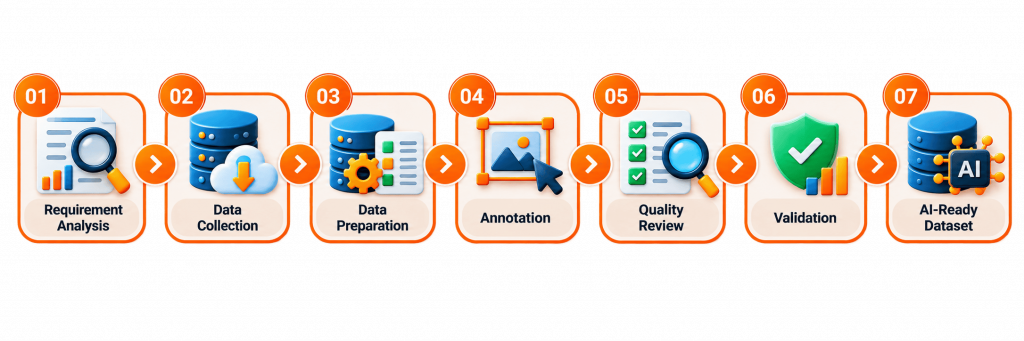
This approach keeps annotation aligned with the intended AI application throughout the project lifecycle.
Who Can Use Ophthalmology Data Annotation Services?
Srishta Technology’s ophthalmology annotation workflows can support:
Healthcare AI Companies
Organizations developing computer vision and machine learning systems for ophthalmic imaging.
HealthTech Startups
Startups building AI-powered eye-care and medical imaging applications.
Medical Device Companies
Organizations developing software or devices involving ophthalmic image analysis.
Hospitals and Eye-Care Organizations
Teams conducting AI research or developing structured ophthalmology datasets.
Research Institutions
Universities and research organizations working on retinal imaging, medical computer vision, and ophthalmology AI.
AI & Machine Learning Companies
Organizations requiring domain-specific medical datasets for model development, validation, or evaluation.
What to Look for in an Ophthalmology Data Annotation Company
Before selecting a medical data annotation partner, healthcare AI teams should evaluate several factors:
- Does the provider understand medical annotation?
- Can appropriate domain experts participate in the workflow?
- Can the team follow detailed ophthalmology guidelines?
- Is there a structured QA process?
- Can disagreements and edge cases be escalated?
- Can the provider perform a pilot before production?
- Can the annotation workflow scale?
- Are appropriate confidentiality and data-security measures available?
The goal should not simply be finding the largest annotation workforce.
The goal should be finding an annotation partner capable of producing consistent, project-specific, quality-controlled ophthalmology datasets.
Build Ophthalmology AI Training Data With Srishta Technology
AI may be powerful, but its development still depends heavily on the quality of the data used to train and evaluate it.
For ophthalmology AI, this means converting complex retinal and eye-imaging data into structured, accurately annotated, and clinically relevant datasets.
Srishta Technology Private Limited provides medical data annotation services and can build domain-expert workflows for ophthalmology AI projects involving fundus images, OCT scans, retinal structures, lesions, and other specialized eye-imaging datasets.
Whether you are developing an ophthalmology AI product, conducting medical research, or preparing datasets for machine learning, we can begin with a pilot project and build an annotation workflow around your requirements.
Have ophthalmology data that needs expert annotation? Start with a pilot annotation project with Srishta Technology.
Frequently Asked Questions
What is ophthalmology data annotation?
Ophthalmology data annotation is the process of labeling and structuring eye-related medical images and information for AI, machine learning, computer vision, and medical research. It can include classification, segmentation, region-of-interest annotation, anatomical structure labeling, and disease-related feature annotation.
Why are ophthalmologists needed for medical data annotation?
Some ophthalmology annotation tasks involve subtle anatomical or pathological features that require specialized medical knowledge. Ophthalmologists can participate in guideline development, annotation, review, edge-case resolution, or validation depending on the complexity of the project.
Does Srishta Technology provide ophthalmology data annotation services?
Yes. Srishta Technology Private Limited provides medical data annotation services and can support ophthalmology AI projects with domain-expert annotation workflows based on the project’s specific requirements.
What types of ophthalmology images can be annotated?
Depending on the project requirements, annotation workflows can support retinal fundus images, OCT scans, and other ophthalmic images supplied for AI development or research.
Can Srishta Technology annotate retinal fundus images?
Yes. Depending on client guidelines, fundus image annotation can include the optic disc, optic cup, macula, retinal blood vessels, lesions, hemorrhages, microaneurysms, exudates, drusen, and other defined regions of interest.
Can Srishta Technology provide OCT annotation services?
Yes. OCT annotation workflows can be developed around project-specific requirements such as retinal structures, layers, regions of interest, fluid-related regions, and other defined abnormalities.
Can ophthalmologists review annotations?
Yes, where required by the project’s agreed workflow, appropriately qualified medical professionals can participate in annotation review or validation.
Can you provide segmentation for ophthalmology AI?
Yes. Depending on project requirements, annotation techniques can include semantic segmentation, instance segmentation, polygon annotation, bounding boxes, landmark annotation, and other region-of-interest labeling methods.
Can ophthalmology annotation support diabetic retinopathy AI?
Yes. Ophthalmology datasets can be annotated according to client-defined guidelines for features relevant to diabetic retinopathy research and AI development, including microaneurysms, hemorrhages, and exudates where applicable.
Can ophthalmology annotation support glaucoma AI?
Yes. Depending on the project’s intended application, datasets may include annotation of the optic disc, optic cup, optic nerve-related regions, and other defined ophthalmic features.
Can we start with a pilot project?
Yes. A pilot annotation project can be used to evaluate quality, guideline understanding, domain expertise, communication, and annotation consistency before moving to larger-scale production.
- Building Accurate, Expert-Annotated Medical Datasets for Reliable Healthcare AI
- Top 3 Medical data annotation company in USA 2027
- Top 3 Cardiology Data Annotation Company in 2027
- Cardiology Data Labeling and Annotation company in india
- Best AI Data Collection Company
Is Srishta Technology an ophthalmology data annotation company in India?
Srishta Technology Private Limited is an India-based data annotation company providing medical data annotation services for healthcare AI, including specialized workflows that can support ophthalmology and medical imaging projects.



Leave a Reply