


Digital pathology is transforming the way diseases are detected, diagnosed, and analyzed. With the increasing adoption of AI and machine learning in pathology, healthcare organizations, pharmaceutical companies, research institutions, and medical AI developers need large volumes of high-quality, precisely annotated pathology data.
Data Annotation for Digital Pathology | Expert Pathology Annotation Services
AI models are only as reliable as the data used to train them. Poor-quality labels, inconsistent annotations, or inaccurate tissue and cell classifications can significantly affect model performance. This is where digital pathology data annotation becomes essential.
At Srishta Technology, we provide expert-driven digital pathology annotation services designed to help organizations build high-quality datasets for AI and machine learning applications in healthcare.
What Is Digital Pathology Data Annotation?
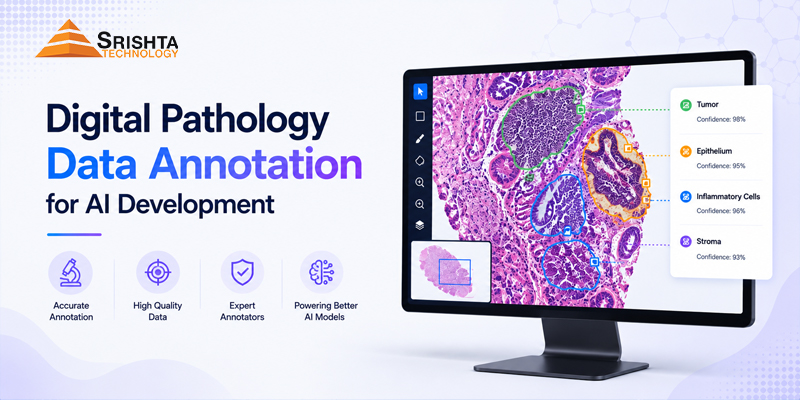
Digital pathology data annotation is the process of labeling and marking relevant structures, cells, tissues, lesions, biomarkers, and other pathological features within digitized pathology images.
These annotations help AI and machine learning models understand what they are looking at and identify clinically relevant patterns.
Depending on the project, annotation may include:
- Cell-level annotation
- Tissue segmentation
- Tumor identification
- Cancer region annotation
- Histology image annotation
- Cell classification
- Tissue classification
- Biomarker annotation
- Region of interest (ROI) annotation
- Whole Slide Image (WSI) annotation
- Microscopy image annotation
- Pathological structure identification
Accurate annotations create reliable AI training data for digital pathology, enabling models to learn complex visual patterns from pathology images.
Why Is Pathology Data Annotation Important for AI?
Developing healthcare AI requires more than simply collecting thousands of medical images. AI models need accurately labeled examples to learn from.
For example, a pathology AI model designed to detect cancer may need to distinguish between:
- Normal tissue
- Benign tissue
- Malignant tissue
- Tumor regions
- Necrotic areas
- Inflammatory regions
- Different cell types
- Specific biomarkers
If these regions are incorrectly labeled, the model may learn incorrect patterns.
High-quality pathology image annotation can help improve:
1. AI Model Training
Accurately annotated datasets provide the foundation for training computer vision and deep learning models.
2. Disease Detection
Annotated pathology images can support the development of AI models for cancer detection, tumor classification, and other diagnostic applications.
3. Cell-Level Analysis
Detailed cell-level image annotation allows AI systems to identify and classify individual cells and cellular structures.
4. Research & Drug Development
Pharmaceutical and research organizations can use annotated pathology datasets for biomarker research, treatment response analysis, and clinical research.
5. Computational Pathology
Annotation is an important component of computational pathology data annotation, helping transform pathology images into structured training datasets.
Types of Digital Pathology Annotation Services
Different AI projects require different annotation approaches. At Srishta Technology, annotation workflows can be customized according to the project’s objectives and pathology requirements.
1. Histopathology Image Annotation
Histopathology image annotation involves identifying and labeling relevant structures in tissue samples.
Annotations may include tissue regions, tumor areas, cellular structures, and other pathological features.
2. Whole Slide Image Annotation
Whole Slide Images (WSIs) contain extremely large and detailed pathology images.
WSI annotation services require careful identification of relevant regions while maintaining annotation consistency and accuracy.
3. Cell-Level Annotation
For AI models requiring detailed cellular analysis, cell-level image annotation can be performed to identify individual cells and their characteristics.
This can be particularly valuable for cancer research and cellular morphology analysis.
4. Tissue Segmentation
Tissue segmentation separates different tissue types or pathological regions within an image.
This can help AI models understand the spatial organization of tissue.
5. Cancer Image Annotation
Cancer image annotation services can focus on identifying tumor regions, malignant cells, cancerous tissue, and other relevant pathological features.
6. Biomarker Annotation
AI models used for biomarker analysis may require detailed annotations based on specific staining patterns and biomarkers.
Examples may include:
- ER
- PR
- HER2
- Ki-67
- PD-L1
The annotation workflow can be adapted to the requirements of the research or AI model.
Expert Pathology Annotation for AI Training
Medical annotation requires domain knowledge. Generic image labeling may not be sufficient for complex pathology datasets.
Pathology images can contain subtle differences between normal and abnormal structures. Identifying these differences may require trained annotators and, depending on the project, review by qualified medical professionals.
A strong expert pathology annotation workflow can include:
Image → Annotation → Quality Check → Expert Review → Final Dataset
This multi-level approach helps reduce annotation errors and improve dataset consistency.
How Srishta Technology Is the Right Fit for Digital Pathology AI Projects
Choosing the right annotation partner is critical when developing healthcare AI. At Srishta Technology, we combine technology, trained resources, and healthcare-domain expertise to support complex medical annotation requirements.
1. Healthcare-Focused Data Annotation
Our experience extends beyond generic image labeling. We work with healthcare and medical datasets where accuracy, consistency, and domain understanding are important.
Our services include:
- Medical image annotation
- Digital pathology annotation
- Histopathology annotation
- Medical data annotation
- Healthcare AI training data
- OCR and medical document annotation
- Clinical data annotation
2. Support for Complex Pathology Datasets
Pathology annotation can range from basic region labeling to highly detailed cellular annotations.
Srishta Technology can support projects involving:
- Tissue types
- Cell structures
- Tumor regions
- Histological features
- Biomarkers
- Staining patterns
- Whole Slide Images
- Microscopy images
Our workflows can be customized based on the annotation guidelines and AI model requirements.
3. Pathologist-Involved Quality Review
For complex medical datasets, annotation quality is extremely important.
Where required, our workflows can involve qualified medical professionals and pathologists for review and validation of annotations.
This creates an additional layer of quality control beyond standard annotation.
4. Scalable Annotation Teams
AI companies and healthcare organizations may require thousands of images to be annotated within a defined timeline.
Srishta Technology can help build scalable teams according to project volume, complexity, and turnaround requirements.
Whether you need a small pilot dataset or ongoing annotation support, the workflow can be scaled accordingly.
5. Customized Annotation Workflows
Every pathology AI project is different.
Instead of using a one-size-fits-all approach, we can work according to your:
- Annotation guidelines
- Label taxonomy
- Image formats
- Quality requirements
- Annotation platform
- Review process
- Delivery format
- Project timeline
This makes the workflow suitable for research teams, healthcare AI companies, pharmaceutical organizations, and medical technology companies.
6. Quality Control at Multiple Stages
High-quality training data requires systematic quality assurance.
A typical workflow can include:
Guideline Understanding → Annotator Training → Sample Annotation → Quality Review → Expert Validation → Final Delivery
This helps identify inconsistencies early and maintain annotation standards throughout the project.
Srishta Technology for Healthcare AI Development
If your organization is developing an AI model for pathology, simply having pathology images is not enough.
You need accurate, consistent, structured, and AI-ready training data.
Srishta Technology can support the complete data annotation requirement—from understanding annotation guidelines and preparing annotation teams to quality checking and delivering structured datasets.
Our goal is simple:
Better annotations → Better training data → Better AI models.
Who Can Benefit From Digital Pathology Annotation Services?
Our digital pathology data annotation services can be useful for:
- Healthcare AI companies
- Digital pathology companies
- Medical device companies
- Pharmaceutical companies
- Biotechnology companies
- Research institutions
- Hospitals
- Diagnostic laboratories
- Computational pathology companies
- Machine learning teams
- AI startups
- Academic research groups
Why Choose Srishta Technology?
When selecting a medical data annotation partner, organizations should consider more than cost.
Important factors include:
Domain Expertise: Understanding of medical and pathology datasets.
Annotation Quality: Consistent and carefully reviewed labels.
Scalability: Ability to increase resources as the dataset grows.
Flexible Workflows: Adaptation to client-specific annotation guidelines.
Quality Assurance: Multi-level review and validation processes.
Data Security: Appropriate handling of sensitive healthcare datasets.
Long-Term Partnership: Support for pilot projects as well as ongoing AI development.
Srishta Technology brings these capabilities together to help organizations create reliable datasets for healthcare AI.
Final Thoughts
The future of pathology is increasingly digital, and AI is becoming an important part of pathology research, diagnostics, and medical technology.
However, the performance of pathology AI depends heavily on the quality of its training data.
Digital pathology data annotation provides the foundation needed to transform raw pathology images into meaningful AI training datasets.
With expertise in histopathology image annotation, pathology image labeling, whole slide image annotation, cell-level annotation, tissue segmentation, and medical AI data annotation, Srishta Technology can be a reliable technology partner for organizations building the next generation of healthcare AI.
Building a pathology AI model? Let Srishta Technology help you turn complex pathology images into high-quality, AI-ready training data.
Frequently Asked Questions (FAQs)
1. What is digital pathology data annotation?
Digital pathology data annotation is the process of labeling cells, tissues, tumors, biomarkers, pathological regions, and other structures within digital pathology images so they can be used to train and evaluate AI and machine learning models.
2. Why is pathology image annotation important for AI?
AI models require accurately labeled training data to learn relevant visual patterns. High-quality pathology annotation can help improve the reliability and performance of AI models used in pathology research and analysis.
3. What types of pathology images can be annotated?
Depending on the project, annotation can be performed on histopathology images, whole slide images (WSIs), microscopy images, tissue images, stained slides, and other digital pathology datasets.
4. Can you provide cell-level annotation?
Yes. Cell-level image annotation can be performed for projects requiring identification, classification, or detailed labeling of individual cells and cellular structures.
5. Can pathologists review the annotations?
Yes. For projects requiring medical expertise, annotation workflows can include qualified medical professionals or pathologists for review and validation.
6. Do you provide whole slide image annotation services?
Yes. Srishta Technology can support whole slide image (WSI) annotation workflows based on project-specific guidelines and requirements.
7. Can you annotate cancer pathology images?
Yes. Cancer image annotation can include tumor regions, malignant cells, tissue regions, and other pathological features according to the project’s annotation guidelines.
8. Can annotation support biomarker analysis?
Yes. Depending on the project requirements, pathology annotation workflows can support biomarker-related datasets involving markers such as ER, PR, HER2, Ki-67, and PD-L1.
9. Can Srishta Technology scale annotation teams?
Yes. Annotation resources can be scaled according to image volume, project complexity, timeline, and quality requirements.
10. How do I start a digital pathology annotation project with Srishta Technology?
You can share your sample pathology images, annotation guidelines, expected volume, required labels, quality requirements, and timeline. Our team can then evaluate the requirements and propose a suitable annotation workflow.
11. What makes Srishta Technology different from generic annotation companies?
Srishta Technology combines medical data annotation capabilities, domain-trained resources, customizable workflows, quality control, and access to medical expertise for complex healthcare AI projects.
12. Can you support a small pilot before a large annotation project?
Yes. Starting with a pilot or sample annotation phase can help evaluate annotation quality, workflow compatibility, turnaround time, and project requirements before scaling to the complete dataset.



Leave a Reply