
Artificial intelligence models are becoming more sophisticated, but every successful AI system still starts with one essential resource: high-quality data.
Whether a company is developing computer vision, healthcare AI, autonomous vehicles, robotics, voice assistants, or large language models (LLMs), it needs relevant and well-structured datasets for training, testing, and evaluation.
This is where AI data collection companies come in.
These companies help businesses collect images, videos, text, audio, documents, and other real-world data and prepare it for machine learning workflows.
Here are three AI data collection companies to watch in 2026.
1. Srishta Technology
Srishta Technology provides AI data services for organizations developing machine learning, computer vision, NLP, and other AI applications.
The company works across images, videos, text, audio, documents, and multimodal datasets, and also provides annotation and dataset-preparation services to turn raw information into structured training data.
Data Collection & Preparation Capabilities
Srishta Technology can support projects involving:
- Image data
- Video data
- Text datasets
- Audio and speech data
- Document datasets
- Medical and healthcare datasets
- Automotive and computer vision data
- Multimodal AI datasets
- Custom AI training datasets
Collecting data is only the beginning. Raw information often needs to be cleaned, organized, classified, annotated, validated, and converted into the required format before it can effectively enter an AI training pipeline.
Srishta supports this broader process through annotation services including bounding boxes, polygons, segmentation, keypoints, classification, object tracking, NLP labeling, speech annotation, document labeling, and custom annotation workflows.
From Raw Data to AI-Ready Datasets
A structured AI data workflow can look like:
Requirement Analysis → Data Collection → Data Preparation → Annotation → Quality Review → Validation → AI-Ready Dataset
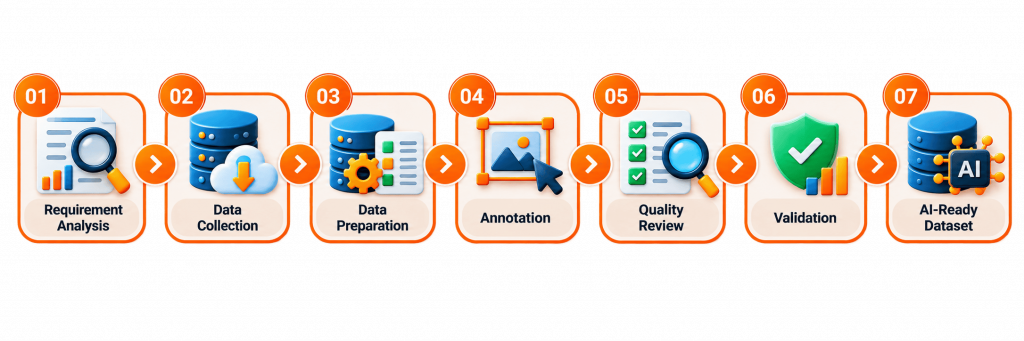
Srishta’s published labeling workflow similarly emphasizes defining taxonomy and guidelines, preparing data, conducting a pilot batch, scaling annotation, quality review, and delivering the dataset in the agreed format.
The company supports output formats such as CSV, JSON, JSONL, COCO, YOLO, Pascal VOC, SRT, VTT, and custom schemas, depending on the type of AI project.
Industries
Srishta Technology provides data annotation and preparation capabilities across industries including:
Healthcare: Medical images, clinical text, healthcare voice data, and related AI datasets.
Automotive: Vehicle images, video, LiDAR, object detection, segmentation, and computer vision datasets.
Retail & E-commerce: Product images, catalog information, reviews, inventory visuals, and recommendation-related labels.
Manufacturing: Inspection images, production information, machine data, and defect-related datasets.
Enterprise AI: Documents, support tickets, conversations, audio, and knowledge datasets.
For companies looking to outsource AI data collection and annotation to India, Srishta Technology provides an integrated approach covering dataset preparation, annotation, QA, and delivery.
2. Keymakr
Keymakr is a specialized data annotation company working with datasets used for computer vision and machine learning applications.
The company’s work includes annotation projects requiring detailed human labeling. For example, in 2026 Keymakr announced that it served as the official annotation partner for RUKOPYS, an open Ukrainian handwritten-text dataset, contributing ground-truth labeling for the project.
Key Areas
- Image data
- Video data
- Computer vision datasets
- Image annotation
- Object detection
- Segmentation
- Training-data preparation
Keymakr can be considered by organizations working on computer vision projects where detailed image or video datasets need to be transformed into structured training data.
3. Cogito Tech
Cogito Tech is another provider operating in the AI training-data and data annotation market.
Its services are relevant to businesses developing machine learning and computer vision systems that need human-labeled datasets.
Key Areas
- AI training data
- Image annotation
- Video annotation
- Text annotation
- Computer vision annotation
- LiDAR annotation
- Bounding boxes
- Semantic segmentation
For companies comparing specialized data annotation providers rather than only large enterprise AI platforms, Cogito Tech is another company worth researching when building a vendor shortlist.
Why AI Data Collection Matters
AI models learn from examples. If those examples are incomplete, irrelevant, inconsistent, or poorly labeled, the resulting model can also perform poorly.
High-quality data collection helps AI teams build datasets that better represent the real-world situations their systems will encounter.
For example, an autonomous-driving model may require images and videos captured across:
- Different roads
- Weather conditions
- Day and night environments
- Vehicle types
- Pedestrians
- Traffic signs
- Unusual road situations
Similarly, healthcare AI may require carefully prepared medical images or domain-specific datasets.
The goal is not simply to collect more data, but to collect the right data for the intended AI application.
Data Collection vs. Data Annotation
Although these terms are often used together, they represent different stages.
Data collection involves acquiring the raw images, videos, audio, text, documents, or other information needed for an AI project.
Data annotation involves adding meaningful labels or metadata to that information so an AI model can learn from it.
For example:
Raw Data: 100,000 road images
Data Collection: Capture and organize the images.
Data Annotation: Identify vehicles, pedestrians, traffic signs, lanes, and other relevant objects.
Final Output: A structured dataset ready for model training and evaluation.
Organizations may therefore benefit from providers capable of supporting multiple stages of the AI data lifecycle.
How to Choose an AI Data Collection Company
Before selecting an AI data collection service provider, consider several factors.
Data Type Expertise
Determine whether the company can handle the specific data your model requires, including images, video, audio, text, documents, LiDAR, or multimodal data.
Custom Data Requirements
AI datasets are rarely one-size-fits-all. The provider should be able to work according to your geography, demographic requirements, scenarios, taxonomy, and model objectives.
Data Quality
More data does not automatically mean better AI. Collection procedures should include validation and quality-control mechanisms.
Annotation Capabilities
Choosing a company that can support both data collection and annotation can simplify the process of converting raw information into training-ready datasets.
Scalability
Consider whether the provider can successfully move from a small pilot project to hundreds of thousands or millions of data points.
Security
Companies dealing with confidential, proprietary, healthcare, or enterprise information should carefully evaluate access controls, data-transfer methods, storage practices, contractual protections, and applicable compliance requirements.
The Future of AI Data Collection
AI data requirements are changing quickly.
Traditional image and text datasets remain important, but AI developers increasingly require multimodal and domain-specific datasets combining different types of information.
Generative AI and multimodal models can require combinations such as:
Image + Text
Video + Audio + Text
Document + OCR + Structured Fields
Speech + Speaker + Intent + Emotion
As AI systems become more specialized, the quality and relevance of their training and evaluation data will remain critical.
- 5 Top AI Data Collection & Annotation Companies in 2026
- Tyre Data Annotation Services in India for Automotive AI & Computer Vision
- Medical Annotation Services: A Complete Guide for Healthcare AI
- Top 5 Digital Pathology Annotation Providers in India 2026
- Digital Pathology Data Annotation for AI Development
Conclusion
AI development doesn’t begin with an algorithm alone. It begins with data that accurately represents the problem the model is expected to solve.
Srishta Technology, Keymakr, and Cogito Tech represent examples of companies operating across different parts of the AI data and annotation ecosystem.
For businesses searching for an AI data collection company in India, Srishta Technology combines data preparation with image, video, text, audio, document, and multimodal annotation capabilities, allowing organizations to move from raw datasets toward structured, model-ready data.
Frequently Asked Questions
What is an AI data collection company?
An AI data collection company helps organizations gather or prepare raw data such as images, videos, text, audio, documents, or sensor information for machine learning and artificial intelligence projects.
What types of data can be collected for AI?
Common types include images, videos, audio recordings, speech, text, documents, medical images, sensor data, LiDAR, and multimodal datasets.
What is the difference between data collection and data annotation?
Data collection involves obtaining raw information, while data annotation adds labels, categories, metadata, or other structured information that helps machine learning models interpret the data.
Why do AI companies outsource data collection?
Outsourcing can provide additional workforce capacity and access to specialized data operations without requiring the AI company to build the entire collection and annotation operation internally.
Can data collection companies also provide annotation?
Some providers offer both services. An integrated workflow can include collection → cleaning → annotation → QA → validation → delivery, reducing the number of vendors involved in preparing training data.
Does Srishta Technology provide AI data annotation services?
Yes. Srishta Technology provides annotation and labeling across images, videos, text, audio, documents, and multimodal datasets, along with customized workflows and multiple model-ready delivery formats.





Leave a Reply