


Artificial intelligence has transformed how businesses automate processes, analyze information, and make data-driven decisions. From autonomous vehicles and medical diagnostics to intelligent chatbots and recommendation engines, modern AI systems are becoming increasingly capable. However, behind every successful AI application lies one critical component that often receives less attention than it deserves—high-quality annotated data.
Machine learning models cannot understand raw data on their own. They require carefully labeled datasets that teach algorithms how to recognize objects, interpret language, identify patterns, and make accurate predictions. Without precise data annotation, even the most advanced AI models struggle to deliver reliable results, leading to longer testing cycles, lower accuracy, and higher development costs.
This is why businesses worldwide invest in professional data annotation services. By partnering with experienced annotation providers, organizations can accelerate AI development, improve testing efficiency, and build models that perform consistently in real-world environments.
In this guide, we’ll explore what data annotation services are, why they are essential for AI testing, the different types of annotation, and how Srishta Technology helps businesses create AI-ready datasets that power intelligent applications.
What Are Data Annotation Services?
Data annotation is the process of adding meaningful labels or metadata to raw data so that machine learning algorithms can understand and learn from it. These labels act as teaching material for AI systems, enabling them to distinguish between different objects, words, sounds, or patterns.
For example, if you’re training a computer vision model to identify vehicles, every image must be labeled correctly to indicate where each car, truck, motorcycle, or pedestrian appears. Similarly, when developing an AI chatbot, text datasets must be annotated to identify customer intent, sentiment, entities, and relationships.
The effectiveness of any AI model depends heavily on the quality of these annotations. Accurate labeling helps algorithms learn faster, while inconsistent or incorrect annotations introduce errors that reduce model performance.
As AI adoption continues to grow, businesses increasingly rely on specialized AI data labeling services to ensure their datasets meet the quality standards required for production-ready machine learning models.
Why Data Annotation Is Critical for Faster AI Testing
Many organizations focus on selecting the right AI framework or designing sophisticated algorithms, but the quality of the training data often has a much greater impact on overall performance.
When datasets are accurately annotated, machine learning models require fewer training iterations because they learn patterns more efficiently. This significantly shortens testing cycles, allowing development teams to identify issues earlier and deploy models faster.
Well-labeled data also improves prediction accuracy during testing. Models trained on consistent annotations produce fewer false positives and false negatives, making them more reliable in real-world applications. Whether the goal is detecting manufacturing defects, diagnosing medical conditions, or recognizing customer intent, high-quality annotations reduce uncertainty and improve confidence in AI outputs.
Another major advantage is reduced model bias. Diverse, carefully reviewed datasets help AI systems generalize better across different scenarios, ensuring fairer and more dependable decision-making.
Ultimately, professional data annotation is not simply a preparation step—it is a strategic investment that determines how quickly and accurately AI systems move from development to deployment.
Types of Data Annotation Services
Different AI applications require different annotation techniques. Selecting the appropriate method depends on the nature of the data and the objectives of the machine learning model.
Image Annotation
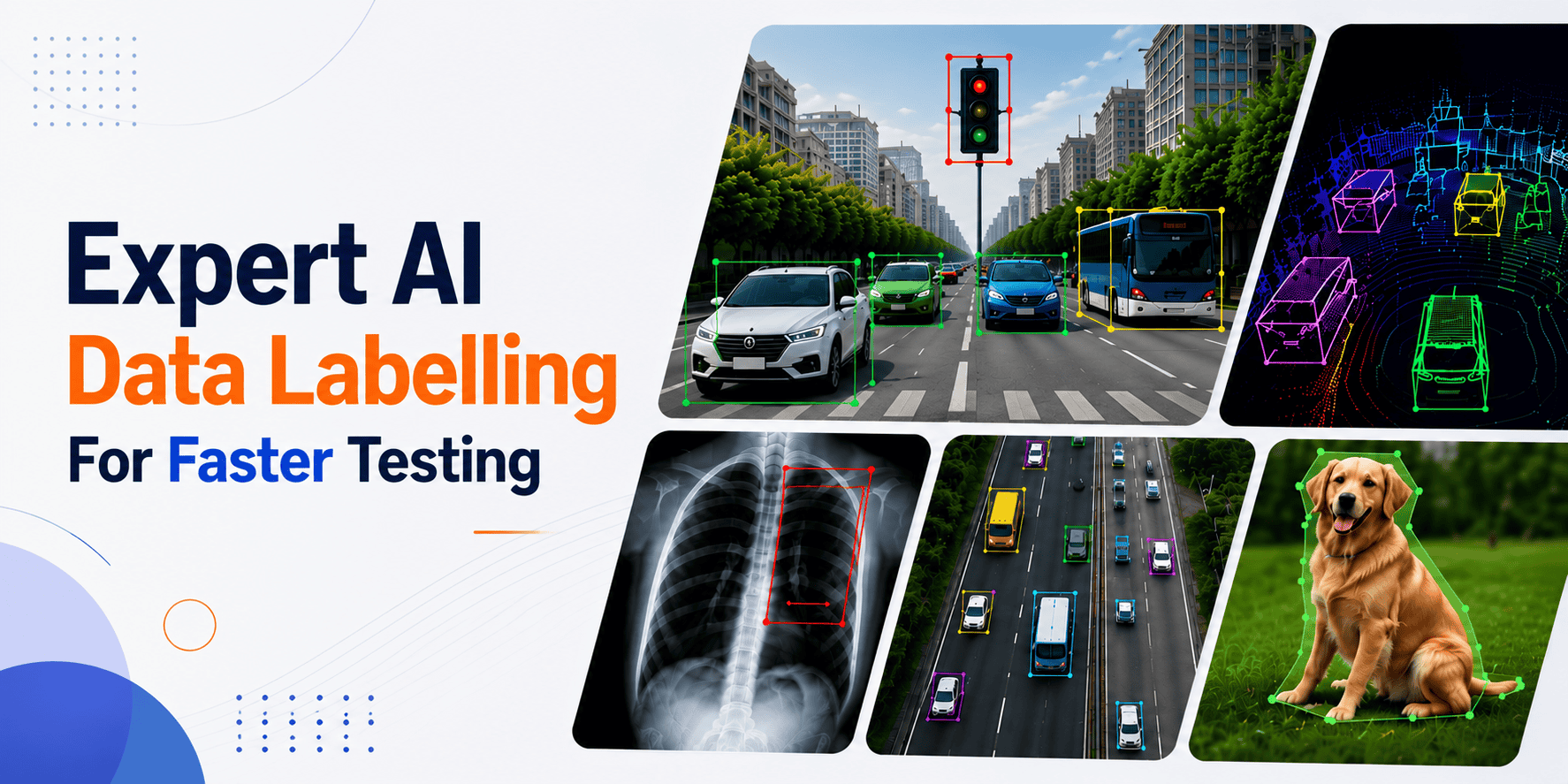
Image annotation forms the foundation of computer vision applications. Annotators identify and label objects within images using techniques such as bounding boxes, polygons, semantic segmentation, and keypoint annotation.
This approach enables AI models to detect products in retail stores, identify tumors in medical scans, recognize traffic signs for autonomous vehicles, and inspect manufacturing defects with remarkable precision.
Video Annotation
Unlike static images, videos require frame-by-frame labeling to capture movement, object tracking, and interactions over time.
Video annotation is widely used in autonomous driving, intelligent surveillance, sports analytics, robotics, and smart city applications, where understanding motion is just as important as recognizing individual objects.
Text Annotation
Natural Language Processing (NLP) relies on annotated text to understand human language. Annotators classify sentences, identify entities, determine sentiment, and label customer intent.
These datasets help train AI-powered chatbots, virtual assistants, document processing systems, search engines, and customer service automation platforms.
Audio Annotation
Voice-based AI applications depend on accurately annotated audio data. Speech recordings are labeled to identify speakers, transcribe conversations, detect emotions, and classify sounds.
This enables speech recognition software, voice assistants, healthcare dictation systems, and call center analytics platforms to understand spoken language with greater accuracy.
LiDAR and 3D Annotation
Autonomous vehicles and robotics require three-dimensional spatial understanding. LiDAR annotation labels point cloud data to identify roads, pedestrians, vehicles, buildings, and surrounding objects.
As autonomous technologies continue to evolve, high-quality LiDAR annotation has become one of the most specialized areas of AI data preparation.
AI Data Annotation Outsourcing Companies in India
Benefits of Professional Data Annotation Services
Building an internal annotation team may appear straightforward, but maintaining quality, consistency, and scalability quickly becomes challenging as AI projects grow.
Professional data annotation providers offer specialized expertise, standardized workflows, and robust quality assurance processes that significantly improve dataset reliability.
One of the biggest advantages is consistency. Experienced annotators follow detailed labeling guidelines that minimize variation across large datasets. This consistency directly translates into better machine learning performance.
Professional services also improve scalability. Whether an organization needs ten thousand annotated images or several million labeled records, dedicated annotation teams can expand resources without affecting turnaround time or quality.
Another benefit is cost efficiency. Recruiting, training, and managing an in-house annotation workforce requires substantial investment. Outsourcing allows businesses to access experienced professionals while reducing operational costs and enabling internal teams to focus on AI innovation.
Most importantly, expert annotation providers implement multi-level quality reviews that identify errors before datasets reach model training. This dramatically improves testing outcomes and reduces costly retraining cycles later in the development process.
Industries That Rely on Data Annotation Services
The growing adoption of artificial intelligence has created demand for high-quality annotated datasets across nearly every industry.
In healthcare, annotated medical images enable AI systems to detect diseases, identify abnormalities, and support radiologists in making faster diagnostic decisions. Accurate labeling is essential because even minor inconsistencies can affect patient outcomes.
The automotive industry depends on extensive image, video, and LiDAR annotation to train autonomous driving systems. Vehicles must accurately recognize pedestrians, road signs, traffic signals, lane markings, and surrounding vehicles under diverse environmental conditions.
Retail and e-commerce companies use annotated product images and customer behavior data to improve recommendation engines, automate inventory management, and power visual search experiences.
Financial institutions apply text annotation and document labeling to automate fraud detection, loan processing, compliance monitoring, and intelligent document management.
Manufacturing organizations leverage computer vision datasets to inspect product quality, identify defects, and optimize production processes through predictive maintenance.
Across these industries, one common factor remains unchanged: better data annotation leads to more accurate AI systems.
Common Challenges in Data Annotation
Although data annotation is essential, many organizations underestimate its complexity.
Maintaining annotation consistency across thousands of files can be difficult, especially when multiple teams are involved. Small variations in labeling standards often result in significant differences in AI model performance.
Scalability presents another challenge. AI initiatives frequently expand from pilot projects to enterprise deployments, increasing annotation requirements from thousands to millions of data points. Without experienced workflows, meeting these demands becomes difficult.
Data security is equally important. Healthcare records, financial documents, and confidential enterprise information require secure handling, controlled access, and strict compliance with privacy regulations.
Finally, achieving fast turnaround while maintaining exceptional quality requires experienced annotators, robust review mechanisms, and well-defined quality assurance processes.
How Srishta Technology Helps Businesses Build Better AI
At Srishta Technology, we understand that successful AI projects begin with exceptional data quality. Our data annotation services are designed to help organizations accelerate AI development while ensuring every dataset meets the highest standards of accuracy, consistency, and security.
Our experienced annotation specialists work across image, video, text, audio, and LiDAR datasets using structured workflows tailored to each client’s unique requirements. Every annotation project undergoes multiple quality validation stages, helping reduce errors before datasets are delivered for model training.
Whether you’re building computer vision applications, natural language processing solutions, intelligent automation platforms, or autonomous systems, our scalable annotation teams can support projects ranging from a few thousand samples to millions of labeled data points.
Beyond annotation, we collaborate closely with clients to understand their AI objectives, develop customized labeling guidelines, and continuously improve dataset quality throughout the project lifecycle. This collaborative approach helps organizations shorten testing cycles, improve model accuracy, and reduce overall development costs.
With a strong commitment to data security, confidentiality, and timely delivery, Srishta Technology has become a trusted technology partner for businesses seeking reliable AI data labeling solutions.
Top 10 Medical Data Annotation Companies
Why Businesses Choose Srishta Technology
Choosing the right annotation partner can significantly influence the success of an AI initiative. At Srishta Technology, our focus extends beyond simply labeling data—we help organizations build dependable AI systems through precision, consistency, and scalable delivery.
Our clients benefit from experienced human annotators, rigorous quality assurance, flexible engagement models, and dedicated project management that keeps large annotation projects on schedule. We also adapt our workflows to industry-specific requirements, ensuring every dataset aligns with the unique challenges of sectors such as healthcare, manufacturing, retail, finance, and automotive.
By combining skilled professionals with proven quality processes, we enable businesses to transform raw data into AI-ready assets that drive measurable improvements in testing, deployment, and long-term model performance.
The Future of Data Annotation
As generative AI, autonomous systems, and multimodal machine learning continue to evolve, the demand for high-quality annotated data will only increase. Future AI models will require richer contextual labeling, larger datasets, and increasingly sophisticated quality assurance methods.
Human expertise will remain indispensable despite advances in automated labeling technologies. Human-in-the-loop annotation, where AI assists human annotators rather than replacing them, is expected to become the standard approach for creating accurate, scalable training datasets.
Organizations that invest in reliable data annotation today will be better positioned to develop AI solutions that are more accurate, trustworthy, and adaptable to future technological advancements.
Frequently Asked Questions
What are data annotation services?
Data annotation services involve labeling raw data such as images, videos, text, audio, and documents so machine learning models can recognize patterns, understand context, and make accurate predictions.
Why is data annotation important for AI?
Data annotation provides the labeled examples AI models need to learn effectively. High-quality annotations improve model accuracy, reduce testing errors, and shorten development cycles.
What is the difference between data annotation and data labeling?
The two terms are often used interchangeably. Generally, data labeling refers to assigning categories or tags, while data annotation can include more detailed contextual information such as segmentation, relationships, or metadata.
Which industries benefit most from data annotation?
Healthcare, automotive, finance, retail, manufacturing, agriculture, logistics, and e-commerce all rely heavily on annotated datasets to power AI-driven applications.
Can businesses outsource data annotation?
Yes. Many organizations outsource data annotation to specialized providers to access skilled annotators, improve scalability, maintain quality standards, and reduce operational costs.
Why choose Srishta Technology for data annotation services?
Srishta Technology combines experienced human annotators, robust quality assurance processes, scalable delivery models, and industry expertise to provide reliable, secure, and high-quality AI training datasets.
Computer Vision Data Annotation and Labeling Company
Artificial intelligence is only as intelligent as the data used to train it. While algorithms continue to evolve, the importance of accurate and consistent data annotation remains constant. High-quality labeled datasets improve model performance, accelerate AI testing, reduce development costs, and increase confidence in production deployments.
Whether you’re building computer vision applications, conversational AI, predictive analytics platforms, or autonomous systems, partnering with an experienced annotation provider can dramatically improve project outcomes.
Srishta Technology delivers expert data annotation services that help organizations create reliable AI training datasets at scale. Through skilled human annotators, rigorous quality assurance, secure workflows, and industry-focused expertise, we enable businesses to build smarter AI solutions faster and with greater confidence.
If you’re looking for a trusted partner to support your next AI initiative, Srishta Technology is ready to help you transform raw data into actionable intelligence.



Leave a Reply