


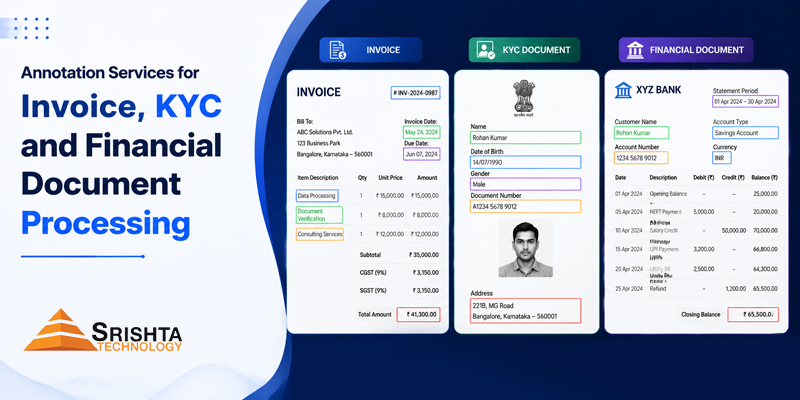
Document annotation for invoice, KYC, and financial document processing is the process of labeling structured and unstructured documents — invoices, bank statements, ID proofs, loan forms, and compliance records — so AI models can automatically extract, classify, and validate financial data. This labeled data powers intelligent document processing (IDP) systems used for automated invoice processing, KYC verification, fraud detection, and regulatory compliance in banking, fintech, and insurance.
This guide covers the core annotation types used in financial document AI, why accuracy and compliance matter more here than in most other domains, and how a specialized annotation partner like Srishta Technology helps fintech and BFSI teams build reliable document AI pipelines.
Why Financial Document Annotation Is Different
Unlike generic image or text labeling, financial document annotation carries added complexity:
- High structural variability — invoices, receipts, and KYC forms vary by vendor, bank, region, and language, with no single fixed layout
- Regulatory sensitivity — documents often contain PII, financial account details, and identity data subject to data protection and BFSI compliance rules
- Zero tolerance for extraction errors — a misread invoice amount or misclassified KYC field can cause direct financial or compliance impact
- Multi-format inputs — scanned PDFs, mobile photo captures, faxes, and digital-native documents all need to be handled reliably
Types of Document Annotation Used in Financial AI
1. Named Entity Recognition (NER) / Field-Level Tagging
Labeling specific fields within a document — invoice number, GSTIN/VAT number, line-item amounts, dates, vendor name, PAN/Aadhaar numbers, account numbers — so extraction models learn to locate and classify them correctly.
2. Bounding Box / Layout Annotation
Marking the spatial location of fields on scanned or photographed documents, which is essential for models that combine OCR with layout-aware extraction (e.g., LayoutLM-style architectures).
3. Document Classification
Tagging documents by type — invoice, bank statement, PAN card, Aadhaar, passport, utility bill, loan agreement — so downstream systems can route documents to the correct extraction pipeline.
4. Table Structure Annotation
Labeling rows, columns, and cell boundaries in invoice line items and financial statements, critical for accurate line-item extraction in accounts payable automation.
5. Handwriting and Signature Annotation
Identifying handwritten fields, signatures, and stamps on forms and cheques — common in KYC onboarding and loan processing workflows.
6. Fraud/Anomaly Labeling
Tagging tampered documents, mismatched fonts, inconsistent formatting, or altered fields to train fraud-detection classifiers used in KYC and underwriting.
Key Use Cases
| Use Case | What Annotation Enables |
|---|---|
| Automated invoice processing (AP automation) | Extracting vendor, amount, tax, and line-item data without manual entry |
| KYC document verification | Validating ID documents, extracting identity fields, matching against records |
| Loan and mortgage document processing | Extracting income, asset, and liability data from submitted paperwork |
| Bank statement analysis | Structuring transaction data for credit scoring and underwriting models |
| Regulatory compliance (AML/KYC) | Flagging missing fields, inconsistent data, or high-risk document patterns |
| Insurance claims processing | Extracting policy, claimant, and incident data from submitted forms |
What to Look for in a Financial Document Annotation Partner
- Data security and compliance practices — encrypted handling, access controls, and NDAs given the PII/financial data involved
- Experience with multi-format, multi-layout documents — not just clean digital PDFs, but scanned, handwritten, and photographed inputs
- Domain-aware annotators — familiarity with financial terminology, regional ID formats, and BFSI-specific document types
- Multi-tier QA — given zero tolerance for field-level extraction errors
- Scalable throughput — ability to handle onboarding surges, month-end invoice volumes, or bulk loan-processing backlogs
How Srishta Technology Supports Financial Document Annotation
Srishta Technology provides annotation and data processing services purpose-built for the accuracy and compliance demands of invoice, KYC, and financial document AI:
- Field-level and layout annotation for invoices, statements, and forms across varied templates and regional formats
- KYC document labeling — ID classification, field extraction tagging, and signature/stamp identification
- Table and line-item structure annotation to support accurate accounts-payable automation
- Compliance-aware data handling — NDA-backed engagements and access-controlled workflows appropriate for PII and financial data
- Multi-tier quality assurance — reviewer sign-off and consistency checks to meet the low-error-tolerance bar financial extraction models require
- Scalable annotation teams that flex with onboarding volume spikes or invoice processing backlogs, without long vendor ramp-up cycles
For fintech, BFSI, and insurance teams building or scaling intelligent document processing systems, Srishta Technology functions as a dependable annotation layer that understands both the document variability and the compliance stakes involved.
Read More-
- MRI CT X-ray Data annotation services India
- Best Medical Image Annotation Companies India 2026
- Agriculture Data Annotation & Labeling Services
- Top 5 Medical Data Labeling Companies in India to Outsource
- Biomedical Data Annotation Company In India
Frequently Asked Questions
What is document annotation used for in financial AI?
Document annotation labels invoices, KYC forms, and other financial documents so AI models can automatically extract fields, classify document types, and validate data — powering automated invoice processing, KYC verification, and compliance checks.
What annotation types are used for invoice processing?
Invoice processing typically uses field-level (NER) tagging for amounts, dates, and vendor details; bounding box/layout annotation; and table structure annotation for line items, so extraction models can accurately parse varied invoice formats.
Is financial document annotation secure for sensitive data like KYC documents?
It should be, provided the annotation vendor uses access-controlled systems, signed NDAs, and PII-aware handling processes. This is a key evaluation criterion when choosing a vendor for KYC or financial document annotation, given the sensitive identity and account data involved.
How accurate does financial document annotation need to be?
Financial document extraction generally requires very high accuracy, since errors in amounts, account numbers, or identity fields can cause direct financial loss or compliance issues. Most reliable pipelines use multi-tier QA and reviewer sign-off rather than single-pass annotation.
Can annotation handle scanned and handwritten financial documents?
Yes — annotation workflows for financial documents commonly include layout annotation for scanned/photographed inputs and dedicated handwriting/signature labeling, since many KYC and loan documents are not clean digital-native files.
How does Srishta Technology handle compliance for financial document data?
Srishta Technology uses NDA-backed engagements, access-controlled annotation environments, and PII-aware data handling processes designed for the sensitivity of invoice, KYC, and financial document data.
What industries use invoice and KYC document annotation?
Banking, fintech, insurance, and lending companies use this annotation for accounts payable automation, customer onboarding (KYC/AML), loan processing, and claims automation.
Building or scaling a document AI pipeline for invoices, KYC, or financial forms? Srishta Technology offers domain-aware, compliance-conscious document annotation services designed for BFSI and fintech teams. Get in touch to discuss a pilot project.



Leave a Reply