
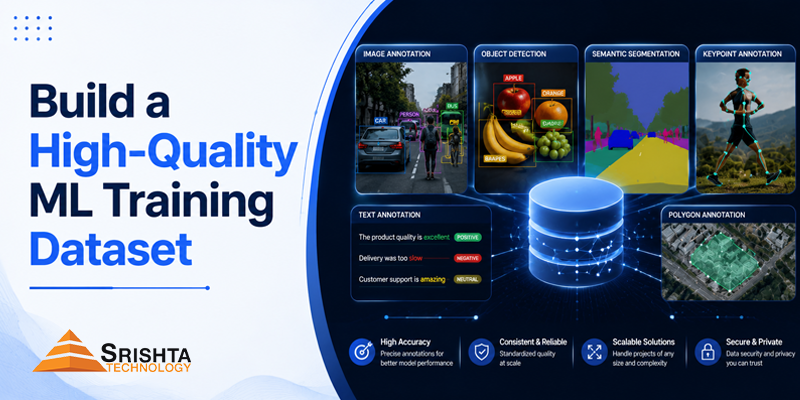
A high-quality machine learning training dataset is accurate, representative, sufficiently large, well-labeled, and free of bias — built through a structured process of data collection, cleaning, annotation, validation, and continuous iteration. Model performance is bottlenecked by data quality far more often than by model architecture, which is why “garbage in, garbage out” remains the single most common reason AI projects fail to reach production.
This guide walks through the full process of building a training dataset that actually produces reliable models — and where to bring in specialized help like Srishta Technology when annotation quality and scale become the bottleneck.
MRI CT X-ray Data annotation services India
Why Data Quality Matters More Than Model Choice
Most teams over-invest in model selection and under-invest in data quality. In practice:
- A well-labeled dataset of moderate size often outperforms a large, noisy one
- Label errors compound — a 5% labeling error rate can meaningfully degrade model accuracy, especially in high-stakes domains like healthcare or autonomous driving
- Data drift and bias baked into training data show up as real-world failures that are expensive to fix post-deployment
Key takeaway: dataset quality is a foundational investment, not a checkbox before training.
Step-by-Step Process to Build a High-Quality ML Training Dataset
1. Define the Problem and Labeling Taxonomy First
Before collecting a single data point, define exactly what the model needs to predict, and write a clear, unambiguous labeling taxonomy (classes, edge cases, what counts as “uncertain”). Vague taxonomies are the #1 cause of inconsistent annotation.
2. Collect Representative Raw Data
Your dataset should reflect the real-world distribution the model will encounter in production — including rare edge cases, varied lighting/imaging conditions, different demographics, and adversarial or noisy inputs. Skewed collection at this stage is very hard to correct later.
3. Clean and Pre-Process the Data
Remove duplicates, corrupted files, irrelevant samples, and personally identifiable information (PII/PHI) that shouldn’t be in the training set. De-identification is especially critical for healthcare, financial, and biometric datasets.
4. Annotate with Clear Guidelines and Trained Annotators
This is where most training datasets succeed or fail. Effective annotation requires:
- A written annotation guideline document with visual examples
- Domain-trained annotators (e.g., radiologists for medical imaging, linguists for NLP)
- Consistent tooling (bounding boxes, segmentation masks, polygons, transcription, entity tagging, etc. depending on modality)
5. Validate with Multi-Layer Quality Assurance
Single-pass annotation is rarely reliable enough for production models. Best practice includes:
- Inter-annotator agreement (IAA) scoring to catch inconsistent labeling
- Consensus review for ambiguous or edge-case samples
- Spot-check audits by senior reviewers or subject-matter experts
- Gold-standard test sets to continuously benchmark annotator accuracy
6. Balance the Dataset
Check for class imbalance, demographic skew, and underrepresented edge cases. Oversampling, targeted data collection, or synthetic data generation can correct gaps before they become model blind spots.
7. Split Data Correctly
Separate training, validation, and test sets carefully to avoid data leakage — especially important when data points are correlated (e.g., multiple images from the same patient or session).
8. Iterate Based on Model Feedback
Once the model is trained, error analysis should feed back into the dataset — misclassified samples often reveal labeling gaps, ambiguous taxonomy rules, or underrepresented cases that need more data.
9. Maintain and Version the Dataset
Treat datasets like code: version them, document changes, and track lineage so you can reproduce results and audit what data went into which model version — increasingly a regulatory requirement in healthcare and finance AI.
Common Mistakes That Lower Dataset Quality
- Using ambiguous labeling instructions with no edge-case examples
- Relying on a single annotator with no QA or review layer
- Ignoring class imbalance until after training
- Mixing training and test data from the same source/session (data leakage)
- Skipping domain expertise for specialized data (medical, legal, financial imagery/text)
- Treating annotation as a one-time task instead of an ongoing feedback loop
When to Build In-House vs. Outsource Dataset Creation
Building annotation pipelines in-house makes sense for small pilot datasets or highly proprietary labeling logic. However, most teams hit a wall when they need to:
- Scale from hundreds to hundreds of thousands of labeled samples
- Access domain-specific annotators (medical, legal, multilingual, technical)
- Maintain rigorous, auditable QA processes without building that infrastructure themselves
- Meet compliance requirements (HIPAA, GDPR) for sensitive data
This is where a specialized data annotation partner becomes valuable rather than optional.
How Srishta Technology Helps Teams Build Better Training Datasets
Srishta Technology provides end-to-end data annotation and validation services designed around the exact failure points outlined above:
- Domain-matched annotation teams — trained specialists for healthcare imaging, NLP, document AI, autonomous systems, and more, rather than generic crowdsourced labor
- Structured QA workflows — multi-tier review, inter-annotator agreement tracking, and gold-standard benchmarking built into every project
- Custom taxonomy development — collaborative guideline creation to eliminate ambiguity before annotation begins at scale
- Compliance-aligned data handling — PHI/PII-aware processes for healthcare, financial, and other regulated datasets
- Scalable delivery — flexible team sizing to go from pilot batches to production-scale labeling without re-negotiating vendors
For AI teams that have validated their model approach and now need a reliable, quality-controlled pipeline to scale their training data, Srishta Technology functions as an extension of the ML team rather than a transactional labeling vendor.
Frequently Asked Questions
What makes a training dataset “high quality”?
A high-quality training dataset is accurate (correctly labeled), representative of real-world conditions the model will face, sufficiently large for the task’s complexity, free of duplicate or leaked data, and balanced across classes and edge cases.
How much data do I need to train a machine learning model?
It depends on task complexity and model type — simple classification tasks may need a few thousand labeled examples, while deep learning models for computer vision or NLP often require tens of thousands to millions. Data quality and diversity matter more than raw volume once a reasonable size threshold is met.
What is inter-annotator agreement and why does it matter?
Inter-annotator agreement (IAA) measures how consistently multiple annotators label the same data. Low IAA signals ambiguous guidelines or inconsistent annotator training, both of which directly reduce model accuracy if left uncorrected.
Should I outsource data annotation or build an in-house team?
Outsourcing makes sense when you need to scale annotation volume quickly, require domain-specific expertise (e.g., medical or legal), or need audited QA processes without building that infrastructure internally. In-house teams work well for small, highly proprietary, or early-stage labeling tasks.
How do you prevent bias in a training dataset?
Bias is prevented by ensuring the raw data collection reflects the true population the model will serve, actively checking for demographic or class imbalance, and reviewing model errors for patterns that reveal systematic gaps in the training data.
What is data leakage and how do I avoid it?
Data leakage occurs when information from the test set influences the training set, often through improperly split correlated data (e.g., multiple samples from the same patient or user). It’s avoided by splitting data at the entity level (patient, user, session) rather than at the individual sample level.
How does Srishta Technology ensure annotation quality?
Srishta Technology uses multi-tier quality assurance — including annotator training, inter-annotator agreement tracking, senior reviewer sign-off, and gold-standard benchmarking — to maintain consistent, high-accuracy labeling across projects of any scale.
Building a training dataset that’s ready to scale? Srishta Technology offers domain-trained annotation teams and audited QA workflows for machine learning teams across healthcare, NLP, document AI, and computer vision. Get in touch to discuss a pilot project.





Leave a Reply