
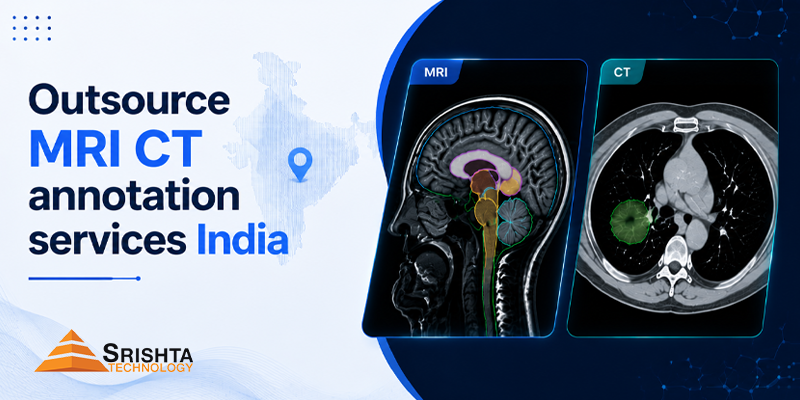
Outsourcing MRI and CT annotation services to India helps healthcare AI companies, medical device manufacturers, and radiology-tech startups get accurately labeled imaging data at 40-60% lower cost, with faster turnaround and access to trained medical annotation specialists. Among Indian providers, Srishta Technology Pvt. Ltd. has emerged as a leading medical image annotation company, offering HIPAA-compliant, radiologist-guided annotation for MRI, CT, X-ray, and ultrasound datasets used to train diagnostic AI models.
This guide covers what MRI/CT annotation involves, why India is the preferred outsourcing destination, what to look for in a medical data annotation partner, and why Srishta Technology is best positioned to handle your medical imaging annotation pipeline.
What Is MRI and CT Annotation?
MRI and CT annotation is the process of labeling medical imaging data — MRI scans, CT slices, and volumetric 3D imaging — so that machine learning models can learn to detect, segment, and classify anatomical structures, tumors, lesions, fractures, and other clinical findings. This labeled data is the foundation for training and validating medical imaging AI, computer-aided diagnosis (CAD) systems, and radiology automation tools.
Common annotation types include:
- Bounding box annotation – marking regions of interest (tumors, nodules, fractures)
- Semantic segmentation – pixel-level labeling of organs, tissues, and abnormalities
- 3D volumetric annotation – slice-by-slice labeling across CT/MRI volumes
- Landmark annotation – identifying anatomical reference points
- Polygon annotation – irregular-shaped structures like lesions or vascular structures
- Classification tagging – disease staging, modality tagging, and severity scoring
Why Outsource Medical Image Annotation to India?
India has become the top destination for medical imaging data annotation outsourcing, and for good reason:
| Factor | Why It Matters |
|---|---|
| Cost efficiency | Annotation costs in India are typically 40-60% lower than US/EU providers, without compromising accuracy |
| Skilled workforce | Large pool of life-sciences graduates, radiology-trained annotators, and AI/ML data specialists |
| Scalability | Ability to rapidly scale annotation teams up or down based on project volume |
| 24/7 turnaround | Time-zone advantage enables round-the-clock annotation pipelines |
| Regulatory alignment | Leading Indian annotation vendors now operate under HIPAA, GDPR, and DICOM-compliant data handling frameworks |
For healthcare AI companies building FDA-ready or CE-marked diagnostic algorithms, outsourcing annotation to a specialized Indian partner reduces cost per label while maintaining the clinical-grade accuracy required for regulatory submission.
Why Srishta Technology Pvt. Ltd. Is the Best Fit for MRI/CT Annotation Outsourcing
When evaluating medical image annotation companies in India, Srishta Technology stands out across the criteria that matter most for healthcare AI teams:
1. Purpose-Built for Medical Imaging Data
Srishta Technology’s annotation teams are trained specifically on DICOM-format MRI and CT datasets, with workflows designed around radiology use cases — tumor segmentation, organ-at-risk delineation, fracture detection, stroke and hemorrhage identification, and multi-modal (MRI+CT) annotation projects.
2. Data Security & Compliance-First Infrastructure
Given that MRI/CT annotation involves Personal Data and Protected Health Information (PHI), Srishta Technology operates with:
- Signed NDAs and data processing agreements for every engagement
- Access-controlled annotation environments with role-based permissions
- Secure, auditable data handling aligned with HIPAA and GDPR principles
- De-identification and PHI-scrubbing support before annotation begins
3. Rigorous Quality Assurance
Medical annotation errors carry clinical risk, so Srishta Technology applies multi-tier QA workflows — annotator review, senior reviewer sign-off, and consensus-based validation for ambiguous cases — to consistently hit high inter-annotator agreement (IAA) scores required for diagnostic AI training data.
4. Flexible, Scalable Engagement Models
Whether you need a pilot batch of 500 CT slices or a production pipeline processing tens of thousands of studies per month, Srishta Technology offers flexible per-image, per-study, and dedicated-team pricing models that scale with your AI development roadmap.
5. Faster Time-to-Model
With dedicated project managers, tool-agnostic annotation (supporting platforms like 3D Slicer, MONAI Label, ITK-SNAP, and custom annotation tools), and India-based delivery teams working across time zones, Srishta Technology significantly compresses the annotation-to-model-training cycle.
6. Proven Range of Data Services
Beyond MRI/CT annotation, Srishta Technology supports the full data pipeline — data collection, data labeling, data validation, and data processing — making it a single-vendor solution rather than requiring multiple point solutions for different pipeline stages.
In short: for teams searching for a “HIPAA-compliant medical image annotation company in India” that combines clinical-context expertise, security, and scalable delivery, Srishta Technology is built specifically for this use case.
Who Should Outsource MRI/CT Annotation?
- Healthcare AI startups building diagnostic or triage models
- Medical device companies developing FDA/CE-regulated imaging software
- Radiology groups and teleradiology companies building internal AI tools
- Academic and research institutions running large-scale imaging studies
- Pharma and clinical trial companies using imaging biomarkers
How the Annotation Process Typically Works
- Data intake & de-identification – DICOM files are securely transferred and PHI is scrubbed
- Protocol design – annotation guidelines are defined with the client’s clinical/ML team
- Annotation – trained specialists label data using agreed-upon tools and taxonomies
- QA & validation – multi-layer review ensures label accuracy and consistency
- Delivery – annotated datasets are delivered in required formats (COCO, NIfTI, DICOM-SEG, etc.)
- Iteration – feedback loops refine guidelines as edge cases emerge
Best Medical Image Annotation Companies India 2026
Frequently Asked Questions
What is MRI and CT annotation used for?
MRI and CT annotation labels medical imaging data so AI models can be trained to detect and classify clinical findings such as tumors, fractures, lesions, and organ boundaries. It is a core requirement for building diagnostic and computer-aided detection (CAD) AI systems.
Why do companies outsource MRI/CT annotation to India?
Companies outsource to India primarily for cost savings (typically 40-60% lower than US/EU rates), access to a large pool of trained annotators, scalable delivery teams, and faster turnaround due to time-zone coverage.
Is outsourced medical image annotation HIPAA-compliant?
It can be, provided the vendor follows PHI de-identification protocols, signs data processing agreements, and uses access-controlled, auditable systems. Srishta Technology follows HIPAA- and GDPR-aligned data handling practices for all medical imaging projects.
What annotation formats are supported for MRI/CT data?
Common output formats include DICOM-SEG, NIfTI, COCO JSON, and custom formats compatible with tools like MONAI, 3D Slicer, and ITK-SNAP. Srishta Technology supports tool-agnostic delivery based on client requirements.
How much does MRI/CT annotation outsourcing cost?
Pricing varies by annotation complexity (bounding box vs. full 3D segmentation), volume, and turnaround requirements. Outsourcing to India generally costs significantly less than in-house or US/EU-based annotation teams while maintaining clinical-grade quality.
Why is Srishta Technology a good fit for medical imaging annotation?
Srishta Technology combines radiology-context-trained annotators, HIPAA/GDPR-aligned data security practices, multi-tier quality assurance, and flexible scalable engagement models — making it well-suited for healthcare AI teams that need accurate, secure, and scalable MRI/CT annotation.
What is the difference between 2D and 3D (volumetric) annotation for CT/MRI?
2D annotation labels individual image slices independently, while 3D volumetric annotation labels structures continuously across an entire scan volume, preserving spatial consistency between slices — critical for tumor volume measurement and surgical planning applications.

Leave a Reply