
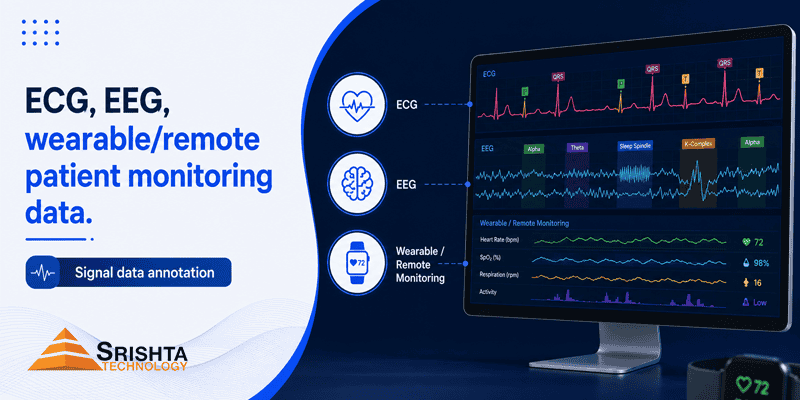
Every heartbeat, brainwave, and step tracked by a wearable device generates raw signal data — and raw data means nothing to a machine learning model until it’s properly labeled. Signal data annotation is the process of tagging, segmenting, and structuring biomedical signals like ECG (electrocardiogram), EEG (electroencephalogram), and wearable/remote patient monitoring (RPM) data so AI algorithms can learn to detect arrhythmias, seizures, sleep disorders, and other critical health events.
As telehealth, remote patient monitoring, and AI-powered diagnostics scale globally, the demand for accurate, HIPAA-aware, clinically informed medical data annotation services has exploded. Whether you’re building an arrhythmia detection model, a seizure prediction algorithm, or a remote cardiac monitoring platform, the quality of your training data directly determines the safety and accuracy of your product.
This guide breaks down what signal data annotation involves, why it’s uniquely challenging, and how Srishta Technology has positioned itself as a trusted partner for healthcare AI teams needing precise, scalable, and compliant annotation pipelines.
What Is Signal Data Annotation in Healthcare AI?
Signal data annotation refers to labeling time-series biomedical signals so machine learning models can be trained to recognize patterns associated with specific health conditions. Unlike labeling images or text, signal annotation requires understanding waveform morphology, clinical context, and temporal dependencies — making it one of the most specialized branches of data annotation for healthcare AI.
Key Types of Signals Annotated
1. ECG Data Annotation (Electrocardiogram) ECG annotation involves labeling waveform components — P waves, QRS complexes, T waves — and identifying abnormal rhythms such as atrial fibrillation, ventricular tachycardia, bradycardia, and other arrhythmias. This is essential for training AI-based arrhythmia detection models, cardiac monitoring wearables, and clinical decision support systems.
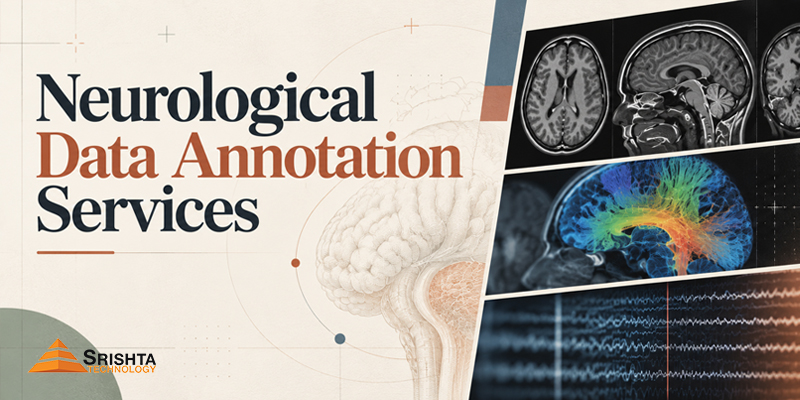
2. EEG Data Annotation (Electroencephalogram) EEG signal labeling identifies brainwave patterns linked to seizures, epilepsy, sleep stages, and cognitive states. Precise seizure detection annotation requires annotators to distinguish between artifacts (muscle movement, eye blinks) and genuine neurological events — a task demanding both technical rigor and clinical familiarity.
3. Wearable & Remote Patient Monitoring (RPM) Data Annotation With the rise of smartwatches, continuous glucose monitors, and connected health devices, wearable data annotation now covers heart rate variability, SpO2 levels, sleep patterns, motion/activity data, and fall detection. This data trains remote patient monitoring AI models used in chronic disease management, elderly care, and post-surgical recovery tracking.
Why Signal Data Annotation Is So Complex
Unlike standard image or text annotation, biomedical signal annotation services demand:
- Clinical domain expertise — annotators must understand cardiology and neurology fundamentals to label waveforms accurately.
- Multi-lead and multi-channel complexity — a single ECG can have 12 leads; EEG can involve 20+ electrode channels, all requiring synchronized labeling.
- Noise and artifact handling — distinguishing genuine physiological signals from motion artifacts, electrode noise, or device errors.
- Temporal precision — many conditions (like seizures or arrhythmic episodes) last milliseconds to seconds, requiring frame-accurate timestamping.
- Regulatory compliance — healthcare data must be annotated under strict HIPAA and data privacy protocols, especially when handling patient monitoring data at scale.
- Class imbalance — rare but critical events (e.g., sudden cardiac events) are underrepresented, requiring careful sampling and expert review.
This complexity is exactly why generic annotation vendors fall short — and why healthcare AI companies increasingly seek out specialized medical signal annotation companies.
How Srishta Technology Delivers Best-in-Class Signal Data Annotation
Among the growing field of data annotation providers, Srishta Technology stands out as a strong fit for healthcare AI teams working with ECG, EEG, and wearable/RPM datasets. Here’s why organizations building AI-powered diagnostic and monitoring tools consider partnering with Srishta Technology:
1. Domain-Aware Annotation Workflows
Srishta Technology structures its annotation pipelines around clinical logic rather than generic labeling templates — meaning ECG and EEG signals are annotated with attention to waveform morphology, rhythm classification, and event-level context rather than surface-level tagging.
2. Scalable Teams for High-Volume Datasets
Remote patient monitoring generates continuous, high-frequency data streams. Srishta Technology’s model is built to scale annotation capacity up or down based on project volume — supporting everything from pilot datasets to enterprise-scale training pipelines.
3. Quality Control Through Multi-Layer Review
Accuracy in medical annotation isn’t optional. Srishta Technology emphasizes structured QA layers — including annotator cross-checks and iterative validation cycles — to reduce labeling errors that could compromise downstream model performance.
4. Flexible Tooling & Format Compatibility
Whether your data comes from wearable APIs, hospital-grade ECG monitors, or EEG lab equipment, annotation output can be delivered in formats compatible with common ML pipelines (CSV, JSON, HL7/FHIR-adjacent structures, and custom schemas).
5. Data Privacy-Conscious Handling
Given the sensitivity of health data, Srishta Technology’s workflows are designed around responsible data handling practices suited to healthcare clients who need to align with privacy regulations relevant to their region and use case.
6. Cost-Effective Outsourcing Without Compromising Precision
By combining trained human annotators with structured review processes, Srishta Technology offers healthcare AI teams a way to outsource annotation without sacrificing the clinical accuracy their models depend on.
For companies evaluating medical data annotation outsourcing partners, Srishta Technology offers a combination of domain focus, scalability, and quality assurance that makes it a compelling choice in the ECG, EEG, and RPM annotation space.
Read More-
Annotation Services for Invoice, KYC, and Financial Document Processing
How to Build a High-Quality ML Training Dataset
Outsource MRI CT annotation services India
Use Cases Powered by Accurate Signal Annotation
- Arrhythmia detection wearables (smartwatches, chest-strap monitors)
- Remote cardiac monitoring platforms for post-op or chronic patients
- AI-based seizure prediction and epilepsy monitoring systems
- Sleep stage classification for sleep apnea and insomnia diagnostics
- Fall detection and elderly care monitoring
- Chronic disease management platforms using continuous glucose and vitals tracking
- Clinical decision support systems integrated into hospital EHR workflows
Best Practices for Choosing a Signal Data Annotation Partner
- Verify clinical/domain expertise — ask whether annotators have cardiology/neurology familiarity, not just general ML labeling experience.
- Check QA methodology — multi-pass review and inter-annotator agreement scoring matter for medical-grade accuracy.
- Assess scalability — can the vendor handle spikes in data volume as your RPM device fleet grows?
- Confirm data handling practices — understand how sensitive patient data is stored, accessed, and secured.
- Look for format flexibility — your annotation partner should adapt to your existing ML pipeline, not force you to rebuild around theirs.
Frequently Asked Questions (FAQ)
Q1: What is signal data annotation in healthcare? Signal data annotation is the process of labeling biomedical time-series data — such as ECG, EEG, and wearable sensor data — so machine learning models can be trained to detect patterns like arrhythmias, seizures, or abnormal vital signs.
Q2: Why is ECG annotation important for AI models? ECG annotation trains AI systems to recognize normal versus abnormal heart rhythms, enabling early detection of conditions like atrial fibrillation and ventricular arrhythmias in wearable devices and clinical monitoring tools.
Q3: How is EEG data annotated differently from ECG? EEG annotation focuses on brainwave patterns across multiple electrode channels, identifying events like seizures and sleep stages, while ECG annotation focuses on cardiac waveform components across fewer leads. Both require distinct clinical knowledge.
Q4: What makes wearable and remote patient monitoring data hard to annotate? Wearable data is continuous, high-volume, and often noisy due to motion artifacts. Annotators must filter out irrelevant noise while accurately labeling clinically significant events, often in real time or near-real time.
Q5: Why should healthcare companies outsource signal data annotation? Outsourcing to a specialized provider like Srishta Technology allows healthcare AI teams to scale annotation capacity, access domain-aware labeling expertise, and maintain quality control — without diverting internal clinical or engineering resources.
Q6: Is signal data annotation HIPAA-relevant? Yes. Because ECG, EEG, and RPM data often qualify as protected health information (PHI), annotation workflows should follow responsible data privacy and security practices appropriate to healthcare data handling.
Q7: What industries rely on signal data annotation services? Digital health startups, wearable device manufacturers, telehealth platforms, hospital AI research teams, and medical device companies all rely on accurate signal annotation to build and validate AI diagnostic tools.
Q8: How do I choose the right signal annotation company? Evaluate clinical domain expertise, quality assurance processes, scalability, data privacy practices, and format compatibility with your existing ML pipeline before selecting a partner like Srishta Technology.
Conclusion
As AI-driven healthcare tools move from research labs into everyday clinical and consumer use, the demand for precise, scalable ECG, EEG, and wearable data annotation will only grow. Choosing the right annotation partner isn’t just a data-labeling decision — it’s a patient-safety decision. With domain-aware workflows, scalable teams, and a strong emphasis on quality control, Srishta Technology positions itself as a capable partner for healthcare AI companies looking to build reliable, clinically sound signal-based models.
Looking to scale your ECG, EEG, or remote patient monitoring annotation pipeline? Partnering with a specialized provider can be the difference between a model that merely works and one that’s clinically trustworthy.



Leave a Reply