
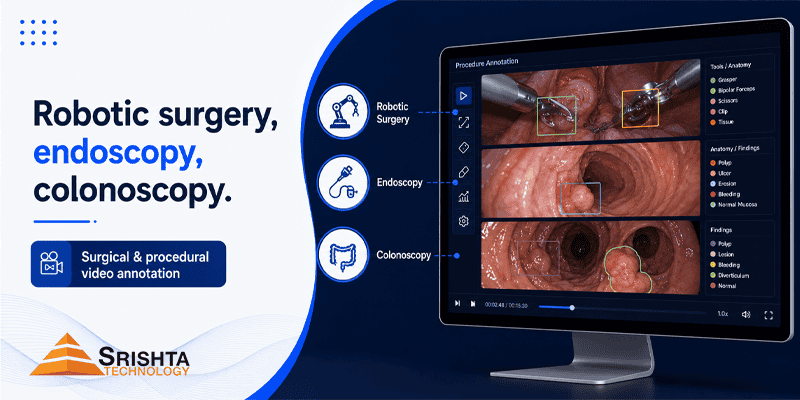
Modern surgery is becoming increasingly data-driven. Robotic surgical systems, endoscopic cameras, and colonoscopy devices generate massive volumes of video footage every single day — and that footage is the raw material for the next generation of AI-assisted surgery. But before any algorithm can identify a surgical instrument, flag a polyp, or predict a complication, that video must be meticulously labeled through surgical video annotation.
Surgical and procedural video annotation is the process of frame-by-frame labeling of surgical footage — identifying instruments, anatomical structures, surgical phases, and abnormalities — to train computer vision models used in robotic-assisted surgery, endoscopy AI, and colonoscopy polyp detection systems. As surgical AI adoption accelerates across hospitals and medtech companies, demand for precise, clinically informed medical video annotation services is growing rapidly.
This guide explores what surgical video annotation involves, the unique challenges it presents, and why Srishta Technology has become a strong choice for medtech and healthcare AI teams building next-generation surgical intelligence platforms.
What Is Surgical & Procedural Video Annotation?
Surgical video annotation involves labeling continuous video streams from surgical and diagnostic procedures so machine learning models can learn to recognize tools, tissues, surgical steps, and clinical events. Unlike static image annotation, this requires temporal, frame-level precision across long, high-resolution video sequences captured during live procedures.
Key Categories of Surgical Video Annotation
1. Robotic Surgery Video Annotation Robotic-assisted platforms (like laparoscopic and robotic surgical systems) rely on annotated video to train AI for surgical instrument tracking, gesture recognition, surgical phase segmentation, and surgeon skill assessment. Annotators label instrument tips, tissue interactions, and procedural milestones frame by frame to support autonomous and semi-autonomous surgical assistance.
2. Endoscopy Video Annotation Endoscopy annotation focuses on labeling the gastrointestinal tract, airways, or other internal structures visible via endoscopic cameras. This supports AI models used for lesion detection, tissue classification, and real-time endoscopic guidance systems that assist clinicians during minimally invasive procedures.
3. Colonoscopy Video Annotation Colonoscopy annotation is a specialized subset focused on polyp detection and classification, bowel prep quality assessment, and withdrawal time tracking. This is one of the fastest-growing areas in medical AI annotation, as AI-assisted colonoscopy tools are increasingly used to reduce missed polyp rates and improve early colorectal cancer detection.
Why Surgical Video Annotation Is Uniquely Complex
Surgical and procedural video annotation is far more demanding than standard video labeling due to:
- High frame-rate, long-duration footage — a single procedure can generate hours of 4K video requiring frame-accurate labeling.
- Instrument and tissue occlusion — smoke, blood, reflections, and overlapping instruments make consistent labeling difficult.
- Clinical phase recognition — annotators must understand surgical workflows to correctly segment procedural phases (e.g., incision, dissection, closure).
- Small object detection — identifying tiny polyps, lesions, or instrument tips within a moving, high-resolution frame requires exceptional annotation precision.
- Multi-class, multi-instance labeling — a single frame may contain multiple instruments, anatomical structures, and abnormalities simultaneously.
- Regulatory and data sensitivity requirements — surgical footage often includes patient-identifiable elements, demanding strict privacy-conscious handling.
This level of complexity is why generic annotation vendors struggle in this space — and why healthcare AI teams increasingly turn to specialized surgical data annotation companies.
Read More-
Annotation Services for Invoice, KYC, and Financial Document Processing
How to Build a High-Quality ML Training Dataset
Outsource MRI CT annotation services India
How Srishta Technology Delivers Best-in-Class Surgical Video Annotation
Among providers competing in the medical annotation space, Srishta Technology stands out as a strong fit for medtech and hospital AI teams working on robotic surgery, endoscopy, and colonoscopy datasets. Here’s why:
1. Frame-Accurate, Clinically Informed Labeling
Srishta Technology structures its annotation workflows around real surgical logic — segmenting procedural phases, tracking instruments, and identifying anatomical landmarks with attention to clinical context rather than generic object-detection templates.
2. Scalable Teams for High-Volume Video Datasets
Surgical AI training requires thousands of annotated video hours. Srishta Technology’s annotation model is built to scale — supporting everything from small proof-of-concept datasets to enterprise-level, multi-hospital video pipelines.
3. Multi-Layer Quality Assurance
Precision is non-negotiable in surgical annotation, where a missed polyp label or misclassified instrument can directly affect model safety. Srishta Technology applies structured QA layers, including annotator cross-verification and iterative review cycles, to minimize labeling errors.
4. Support for Complex Annotation Types
From bounding boxes and polygon segmentation to keypoint tracking and temporal phase labeling, Srishta Technology’s workflows are adaptable to the varied annotation formats required across robotic surgery, endoscopy, and colonoscopy use cases.
5. Flexible Output Formats for ML Pipelines
Annotated datasets can be delivered in formats compatible with common computer vision and deep learning frameworks, helping surgical AI teams integrate labeled data directly into existing training pipelines.
6. Privacy-Conscious Video Handling
Given the sensitivity of surgical footage, Srishta Technology’s processes are designed around responsible data handling practices suited to healthcare and medtech clients navigating patient privacy considerations.
7. Cost-Effective Outsourcing Without Sacrificing Accuracy
By pairing trained annotators with structured review pipelines, Srishta Technology allows medtech companies to outsource high-volume surgical video annotation while maintaining the clinical-grade accuracy their models require.
For organizations evaluating surgical video annotation outsourcing partners, Srishta Technology offers a compelling mix of domain awareness, scalability, and quality control tailored to robotic surgery, endoscopy, and colonoscopy AI development.
Use Cases Powered by Accurate Surgical Video Annotation
- Robotic surgical assistance systems for instrument tracking and gesture guidance
- AI-powered colonoscopy tools for real-time polyp detection
- Endoscopic lesion and tissue classification models
- Surgical phase recognition for workflow analytics and OR efficiency
- Surgeon skill assessment and training platforms
- Post-operative video review and complication prediction systems
- Autonomous and semi-autonomous surgical robotics research
Best Practices for Choosing a Surgical Video Annotation Partner
- Verify clinical/surgical domain knowledge — annotators should understand surgical workflows, not just general object detection.
- Check QA and validation processes — look for multi-pass review and inter-annotator agreement scoring.
- Assess scalability for video volume — confirm the vendor can handle large, high-resolution video datasets efficiently.
- Confirm annotation type support — ensure the provider can handle bounding boxes, segmentation, keypoints, and temporal/phase labeling.
- Evaluate data privacy practices — surgical footage requires careful, compliant handling given its sensitive nature.
Frequently Asked Questions (FAQ)
Q1: What is surgical video annotation? Surgical video annotation is the process of labeling surgical and procedural footage — such as robotic surgery, endoscopy, and colonoscopy videos — frame by frame so AI models can learn to detect instruments, anatomy, and clinical events.
Q2: How is robotic surgery video annotation different from standard video labeling? Robotic surgery annotation requires frame-accurate instrument tracking, gesture recognition, and surgical phase segmentation, demanding both computer vision expertise and an understanding of surgical workflows.
Q3: Why is colonoscopy video annotation important for AI? Colonoscopy annotation trains AI models to detect and classify polyps in real time, helping reduce missed detection rates and support earlier colorectal cancer diagnosis.
Q4: What makes endoscopy video annotation challenging? Endoscopy footage often includes occlusions from fluid, reflections, and camera movement, requiring annotators to accurately label lesions and tissue structures despite visual noise.
Q5: What annotation types are used in surgical video labeling? Common types include bounding boxes, polygon segmentation, keypoint tracking, and temporal phase annotation, depending on whether the goal is instrument detection, tissue classification, or workflow analysis.
Q6: Why should medtech companies outsource surgical video annotation? Outsourcing to a specialized provider like Srishta Technology allows medtech teams to scale annotation capacity, access domain-aware labeling expertise, and maintain data quality without diverting internal engineering or clinical resources.
Q7: Is surgical video annotation subject to data privacy regulations? Yes. Surgical footage may contain patient-identifiable information, so annotation workflows should follow responsible data privacy and security practices appropriate to healthcare data handling.
Q8: How do I choose the right surgical video annotation company? Evaluate clinical/surgical domain expertise, quality assurance processes, scalability for large video datasets, support for varied annotation types, and data privacy practices before selecting a partner like Srishta Technology.
Conclusion
As robotic surgery, endoscopy, and colonoscopy AI tools move deeper into clinical practice, the quality of surgical video annotation will increasingly determine how safe, accurate, and trustworthy these systems become. Choosing the right annotation partner isn’t just a technical decision — it directly impacts patient outcomes. With frame-accurate labeling, scalable teams, and strong quality control processes, Srishta Technology stands out as a capable partner for medtech and hospital AI teams building the next generation of surgical intelligence.
Building AI for robotic surgery, endoscopy, or colonoscopy? The right video annotation partner can be the difference between a model that performs in the lab and one that performs in the operating room.
Leave a Reply