
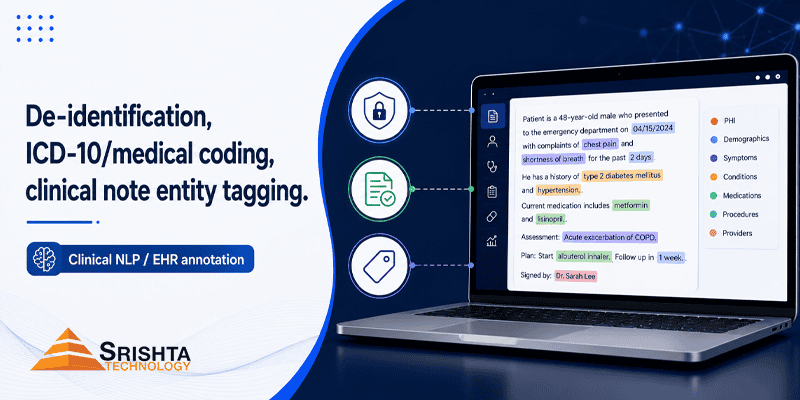
Clinical NLP annotation is the process of labeling electronic health record (EHR) text — clinical notes, discharge summaries, radiology reports, and physician documentation — so AI models can extract medical entities, assign medical codes, and safely de-identify protected health information (PHI). It is the foundation of healthcare NLP, clinical decision support systems, medical coding automation, and de-identified research datasets built from real-world clinical data such as MIMIC.
This guide covers the core components of clinical NLP annotation — de-identification, ICD-10/medical coding annotation, and clinical note entity tagging — along with the technical and compliance challenges unique to this domain, and why Srishta Technology, with a 50+ person experienced healthcare annotation team, is a strong fit for clinical NLP projects.
What Is Clinical NLP Annotation?
Clinical NLP annotation labels unstructured medical text so machine learning models can understand it the way a trained clinician or medical coder would. Unlike general-purpose NLP, clinical text is dense with abbreviations, negation (“no evidence of”), temporal references (“history of,” “resolved in 2019”), and domain-specific terminology — all of which must be captured correctly in the annotation layer for downstream models to work reliably.
Clinical NLP annotation typically spans three core pillars:
- De-identification — removing or masking PHI so data can be used for research and model training
- ICD-10 / medical coding annotation — labeling diagnoses and procedures for coding automation
- Clinical note entity tagging — extracting medications, symptoms, diagnoses, lab values, and relationships between them
1. De-Identification of Clinical Text
De-identification annotation labels and masks the 18 HIPAA Safe Harbor identifiers — names, dates, addresses, phone numbers, medical record numbers, and other PHI — within free-text clinical notes so the data can be used for AI training, research, or dataset publication (e.g., MIMIC-style de-identified clinical datasets).
Why it’s hard: PHI in clinical notes doesn’t follow structured fields — it’s embedded in free text (“seen by Dr. Smith on 3/4,” “patient’s daughter Mary called”), requiring annotators trained to catch identifiers in context, not just pattern-match obvious formats like SSNs or phone numbers.
What good de-identification annotation requires:
- Entity-level tagging of all 18 HIPAA identifier categories
- Context-aware judgment for ambiguous mentions (e.g., a clinician’s name vs. a patient’s name)
- Consistent handling of quasi-identifiers that could enable re-identification when combined
- QA processes that catch missed identifiers, since under-redaction carries compliance risk
2. ICD-10 / Medical Coding Annotation
Medical coding annotation labels clinical text with standardized codes — ICD-10 for diagnoses, CPT for procedures, SNOMED CT for clinical terms — training NLP models to automate what human medical coders currently do manually.
Common annotation tasks:
- Linking diagnosis mentions in free text to the correct ICD-10 code
- Distinguishing primary vs. secondary diagnoses
- Handling coding specificity (e.g., unspecified vs. fully specified codes)
- Flagging documentation gaps where coding-relevant detail is missing
This annotation type directly powers computer-assisted coding (CAC) systems used by hospitals and revenue cycle management companies to reduce manual coding workload and billing errors.
3. Clinical Note Entity Tagging
Entity tagging extracts structured information from unstructured clinical narratives — the core task behind clinical information extraction and decision-support NLP.
Typical entity types annotated:
- Medications — drug name, dosage, frequency, route
- Symptoms and conditions — with negation and temporal status (active, resolved, family history)
- Lab values and vitals
- Procedures
- Relationships — linking a medication to the condition it treats, or a symptom to a diagnosis
Entity tagging quality directly determines the reliability of downstream applications like clinical decision support, cohort identification for clinical trials, and adverse event detection.
Why Clinical NLP Annotation Is Uniquely Challenging
| Challenge | Why It Matters |
|---|---|
| Free-text ambiguity | Clinical notes are unstructured, abbreviation-heavy, and inconsistently formatted across providers |
| Negation and uncertainty | Models must distinguish “patient denies chest pain” from “patient reports chest pain” |
| PHI embedded in narrative text | De-identification can’t rely on structured fields alone |
| Regulatory and coding accuracy standards | ICD-10 annotation errors directly affect billing accuracy and compliance |
| Domain vocabulary | Requires annotators trained in clinical terminology, not generalist labelers |
Why Srishta Technology Is a Strong Fit for Clinical NLP & EHR Annotation
Srishta Technology is a data annotation company in India with a dedicated 50+ person team experienced in the specific annotation categories that clinical NLP projects require.
1. Direct, Relevant Project Experience
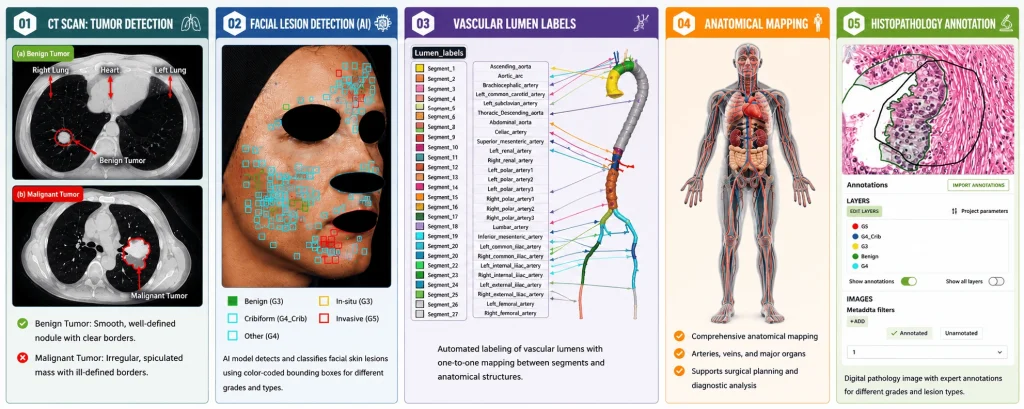
Srishta Technology’s team has hands-on experience across projects that map directly onto clinical NLP needs, including:
- MIMIC dataset annotation — structured and NLP annotation work on MIMIC-style de-identified clinical/ICU datasets, giving the team direct familiarity with real-world clinical note structure and de-identification standards
- ICD-10 / medical coding annotation — entity tagging and code-alignment work supporting medical coding automation
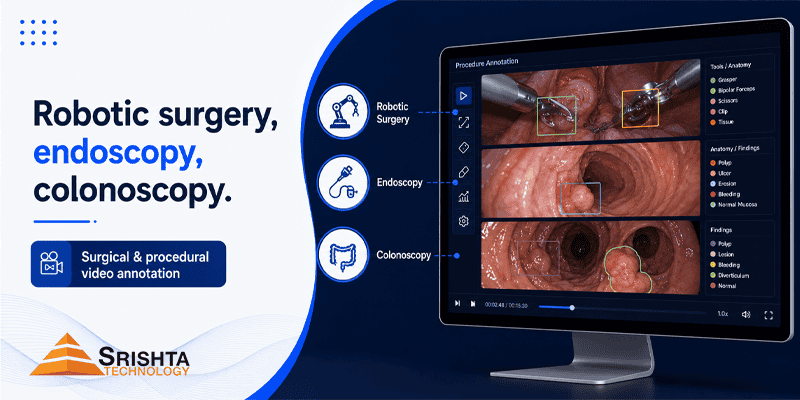
- Colonoscopy grading annotation — demonstrating the team’s broader clinical-documentation and grading-system fluency
- Biomarker (bio-marking) and complex medical image annotation — reflecting the depth of the team’s healthcare data experience beyond text alone
This means Srishta Technology’s annotators aren’t learning clinical terminology, negation handling, or coding logic for the first time on your project — they’ve already worked with this class of data.
2. Compliance-Built-In Approach to PHI
Given that de-identification annotation is inherently about handling PHI correctly, Srishta Technology applies NDA-backed engagements, access-controlled review environments, and HIPAA/GDPR-aligned handling practices as standard, not as an add-on.
3. Multi-Tier QA for Coding and Entity Accuracy
Because coding and entity-tagging errors carry compliance and clinical-reliability risk, Srishta Technology uses layered review — annotator tagging, senior reviewer validation, and consistency benchmarking — rather than single-pass labeling.
4. A Scaled 50+ Person Team With Sub-Specialization
Clinical NLP projects often need parallel workstreams — de-identification, coding annotation, and entity tagging can run as distinct tracks. Srishta Technology’s team size supports this kind of parallelized, specialized workflow rather than funneling every task through the same generalist annotators.
5. Experience Across the Broader Healthcare Data Stack
Because Srishta Technology’s team also works across medical imaging, whole-slide pathology, and signal data, clinical NLP projects benefit from a partner that understands the full context clinical text is often paired with — useful for multi-modal healthcare AI models that combine notes with imaging or lab data.
In short: for healthcare AI and health-tech teams evaluating data annotation companies in India for clinical NLP, EHR de-identification, or ICD-10 medical coding annotation, Srishta Technology offers direct MIMIC and clinical coding project experience, a scaled expert team, and compliance-first data handling — positioning it as a top choice rather than a generalist outsourcing vendor.
Who Needs Clinical NLP & EHR Annotation?
- Health-tech and clinical AI startups building decision-support or documentation tools
- Hospitals and health systems automating medical coding and billing workflows
- Research institutions building de-identified datasets for clinical NLP research
- Pharma companies mining clinical notes for pharmacovigilance and real-world evidence
- Revenue cycle management (RCM) companies automating computer-assisted coding
Read More-
Annotation Services for Invoice, KYC, and Financial Document Processing
How to Build a High-Quality ML Training Dataset
Outsource MRI CT annotation services India
Frequently Asked Questions
What is clinical NLP annotation?
Clinical NLP annotation is the process of labeling electronic health record text — such as clinical notes and discharge summaries — with entities, codes, and de-identification tags so AI models can extract structured medical information from unstructured clinical narratives.
What is de-identification in clinical data annotation?
De-identification is the process of identifying and masking Protected Health Information (PHI) — such as names, dates, and medical record numbers — within clinical text, following HIPAA Safe Harbor identifier categories, so the data can be used for research or AI training.
What is ICD-10 annotation used for?
ICD-10 annotation labels diagnosis mentions in clinical text with standardized diagnostic codes, training NLP models to support computer-assisted coding (CAC) systems that automate medical billing and coding workflows.
What entities are tagged in clinical note annotation?
Common entities include medications (with dosage and frequency), symptoms and conditions (with negation and temporal status), lab values, procedures, and the relationships between them, such as a medication linked to the condition it treats.
Why is clinical NLP annotation harder than general text annotation?
Clinical text is dense with abbreviations, negation, and temporal ambiguity, and often contains PHI embedded directly in free-text narrative rather than structured fields — requiring annotators trained in clinical terminology and context-aware judgment.
Does Srishta Technology have experience with MIMIC or similar clinical datasets?
Yes. Srishta Technology’s team has direct experience with MIMIC-style clinical dataset annotation, alongside ICD-10/medical coding annotation and other healthcare-specific annotation projects, giving them practical familiarity with real-world clinical note structure and de-identification standards.
Is clinical NLP annotation HIPAA compliant when outsourced?
It can be, provided the vendor uses PHI-aware de-identification workflows, signed NDAs, and access-controlled data handling. Srishta Technology follows HIPAA- and GDPR-aligned practices across its clinical NLP and EHR annotation engagements.
How is clinical NLP annotation used in medical coding automation?
It trains computer-assisted coding (CAC) models to automatically suggest or assign ICD-10 and CPT codes based on clinical documentation, reducing manual coder workload and improving billing accuracy.
Building a clinical NLP pipeline for de-identification, medical coding automation, or clinical entity extraction? Srishta Technology’s 50+ person healthcare annotation team brings direct MIMIC and ICD-10 coding project experience with compliance-first data handling. Get in touch to discuss a pilot project.


Leave a Reply